
THE LIFESPAN OF A FACT caused PETE’S EYEBROWS to form a SUPREME ARCH…THRICE!
The Dramatic Premise
John D’Agata has written a brilliant essay about the death of a Las Vegas teenager, Levi Presley, who threw himself from the top of the Stratosphere Hotel. The essay explores the vapidness of Vegas and contemplates what might motivate a person to end their own life. The text captures the zeitgeist of that distant Vegas summer when the tragedy occurred. And D’Agata’s writing honours Levi’s essence whilst imagining his last hours and tracing his last footsteps on his way to the top of the 350 metre high hotel. The reader sees which Levi probably saw and feels how Levi might have felt. The boy’s own mother attests that her son’s soul lives in D’Agata’s essay.
Emily Penrose is a (fictional) editor of a prestigious magazine. She assigns the routine task of fact-checking D’Agata’s article to intern, Jim Fingal. All she expects is a “good-faith” effort. But Fingal is keen to impress and his “good-faith” effort results in a 130-page critique of a 15-page essay, to say nothing of an extended cross-examination of the essayist himself in his Las Vegas home. Fingal challenges everything from the number of strip joints in Vegas, the colour of the bricks at the base of the Stratosphere Hotel and whether Levi’s fall occupied nine seconds, or only eight.
D’Agata argues that – as an essayist rather than a journalist – he is free to play with underlying facts in order to reflect a broader truth. Fingal counters that facts are facts and that any deviation from those facts misleads the trusting reader.
Penrose must decide whether to publish or not to publish. She knows D’Agata’s essay is a prestige piece. It has the potential to change the way readers view the world. But she also knows that its author has played with many of the facts which underpin his narrative.
Which way will she decide?

Photo credit – Sydney Theatre Company
Multiple Viewings
My wife and I have had the pleasure of seeing Lifespan thrice.
The first time was at famed Studio 54 on Broadway in October 2018. Fingal was played by Daniel Ratcliffe of Harry Potter fame. He did a splendid job. D’Agata was played by Bobby Cannavale, who I recognised from support roles in shows like Sex and the City and Ally McBeal.
Our second and third viewings were during Sydney Theatre Company’s production in September / October 2022. Sigrid Thornton, in her STC debut, played Emily Penrose, whilst Charles Wu played Fingal and Gareth Davies played D’Agata.
I trust I don’t sound too parochial in saying that the STC production compares well to the show we saw on Broadway. Some of the acting choices were different, but they were just as engaging. And the STC production added the haunting tones of a live flutist to remind us that Levi was watching on from the wings.
The Moment
Two lines of dialogue stuck in my head from the time I first heard them on Broadway in 2018 all the way through to when I re-heard them at Roslyn Packer Theatre in 2022.
When frustrated by Fingal’s pedantry, D’Agata complains that his adversary views facts like “some herd of purebred white horses galloping majestically, looking down their noses at ambiguity or suspicion or nuance”.
And later, a frustrated Penrose rebukes D’Agata by stating: “It’s one thing to say it was sunny on a day it was cloudy. It’s another thing to claim that a girl hanged herself when in fact she jumped off a building!”.
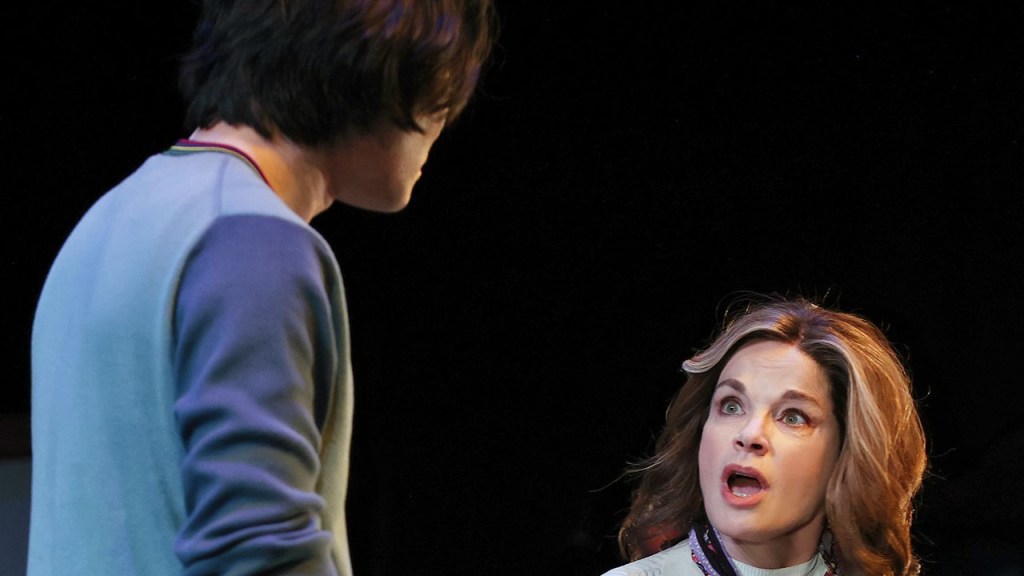
Photo credit – Sydney Theatre Company
One of My Favourite Plays
The reason why The Lifespan of a Fact is scored on my heart is because it exemplifies one of my favourite dramatic tropes – two people arguing when they are both completely right and both completely wrong.
Whenever D’Agata argued that he can alter facts to fit a truthful narrative, I agreed with him. And whenever Fingal countered that some, if not all, facts are unalterable, I agreed with him too. Whenever silent , I viewed the character as defensive and in the wrong. But when they launched a rhetorical counterattack, I changed my mind (again) and concluded they must be in the right.

Photo credit – Sydney Theatre Company
Moreover, Lifespan neatly illustrates my own internal conflict.
In my day job, I’m a Fingal through-and-through. Facts are king. I don’t care how pedantic I might appear, but if the facts are “rubbery” then the advice is invalid. Everything comes back to getting the facts right.
But when I’m writing a travel journal or a short story inspired by life, facts are less important. I’m dealing in primary colours, in the spirit of D’Agata. If a fact is inconvenient or if it interferes with the flow of my story, I’m happy to proceed as though it never existed.
Some facts, in some scenarios, have a short lifespan.
But other facts deserve a lifespan of eternal longevity.
The Lifespan of a Fact is based upon real life events. Levi Presley did, in fact, jump from the Stratosphere Tower in 2002, when he was just 16-years-old.
In 2003, John D’Agata did, in fact, write an extraordinary essay about the event, entitled What Happens There. An edited version of the essay was eventually published in The Believer in 2010 after being fact-checked to within an inch of its life by Jim Fingal.
And in 2012, W H Norton & Co published a book entitled The Lifespan of a Fact which featured D’Agata’s article surrounded by the written exchanges between essayist and fact-checker as they debate the importance of facts versus the importance of creative licence. The book is available on Amazon and well worth the read.
I commend playwrights Jeremy Kareken & David Murrell and Gordon Farrell who crafted the script from the email debate between D’Agata and Fingal.
And if Lifespan is staged again, I suggest you run to the theatre to see it.
The Lifespan of a Fact is not currently playing in Sydney. For more information about the 2022 Sydney Theatre Company production:
http://sydneytheatre.com.au/whats-on/productions/2022/the-lifespan-of-a-fact


Leave a comment