SUPREME EYEBROW ARCH – ⭐️⭐️⭐️⭐️⭐️
The Dramatic Premise
It’s 1844 and a young Jewish man from Rimpar, Bavaria, has just arrived in New York. He marvels at the American musical box playing out, before him, in real time. One window closes and another opens. One man sits down and another stands up. The majesty of the scene sparkles in young Henry Lehman’s youthful eyes and he dreams of endless possibilities.
Soon Henry’s brothers, Emanuel and Mayer, join him in steamy Montgomery, Alabama, where he has settled. The three brothers run a humble store selling fabrics and suits. But Henry, Emanuel and Mayer – `the head’, `the arm’ and `the potato’ – share a keen eye for business. They see an opportunity to collect Alabama cotton from multiple producers and sell it to the garment manufacturers in New York by the wagon load.
They’re on their way.
But we know how this story ends. Anybody who was conscious in 2008 knows that, by then, Lehman Brothers was an investment bank and its collapse heralded the global financial crisis.
So, how did we get from here to there? How did the cotton business, established by three entrepreneurial brothers, morph into a bank, with a share trading arm? And how did that business become so entrenched in American life that its collapse provoked the worst economic disaster since the Great Depression of the 1930’s?
This is the story of the Lehman Brothers, their sons and their grandsons. One hundred and sixty years of family history told over three Acts; Three Brothers, Fathers and Sons and The Immortal.
The Set
My interest in theatre is normally focussed on the writing and the acting.
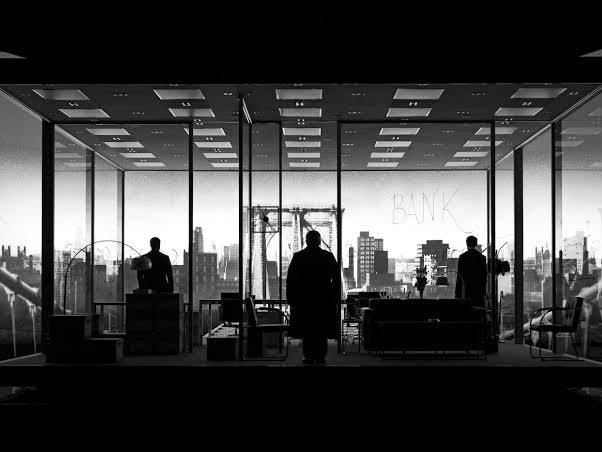
But The Lehman Triology set design deserves special mention.
The entire play is set in an early 21st-century Manhattan office, with three segments; a boardroom, a lounge area and a small office. Even the early scenes, putatively set in Alabama, are played out in that stunning glass cube. It’s not hard to get transported from one place to another, as an immense screen, positioned at the rear of the cube, shifts effortlessly from cotton field, to endless sky to Manhattan skyline, whilst a live pianist plays evocative tunes which echo a Yiddish lullaby.
And then the cube spins, as the actors stride from boardroom to office to lounge area whilst delivering their lines. The combined effect is intoxicating.
The Moment
It’s the third act and the third generation of American-based Lehmans now controls Lehman Brothers.
Young Bobby Lehman has adapted and grown and the business he inherited has survived Black Thursday and the Second World War. By now, Lehman Brothers is no longer a bank that invests in real things, like railways or construction. No, now it deals in the movement of money.
And in one startling epiphany, Bobby Lehman catches a glimpse of his own immortality. People no longer buy what they need. They no longer buy out of necessity. No, now people buy out of instinct. And if people buy out of instinct, banks can lend to anybody. The movement of money will be like a whirlwind, generating profits upon profits. Banks will be at the centre of everything. They will be immortal. And so will the bankers.
The Collapse
The Lehman Trilogy starts and ends with the Lehman Brothers collapse in 2008. Contrary to my expectation, however, the play does not dwell upon this event. It barely even tries to explain it.
Ultimately, The Lehman Trilogy is not about the collapse of Lehman Brothers. It’s a sweeping epic which follows a migrant family from Rimpar, Bavaria, through the Civil War, into the 20th Century, and onto the era of post-WWII consumerism right up to the doorstep of the “greed is good, greed works” generation.
In truth, the story ends when Lehman Brothers ceases to be a family business: when Bobby Lehman dies in 1969. Thereafter, the play works on the premise that the die was already cast and that there was a natural through-line from the end of the Lehman family era to the end of the Lehman Brothers business, some forty-years later.
One way or another, the final business model – so divergent from what Henry, Emanual and Mayer created – was always going to cannibalise itself.
What My Eyebrows Told Me
I enjoyed this production so much that my eyebrows remained in a Supreme Arch throughout its duration.
For more information on the Australian production of “The Lehman Triology”:


Leave a comment