By Arthur Miller
HIGH EYEBROW ARCH – ⭐️⭐️⭐️⭐️
The Dramatic Premise
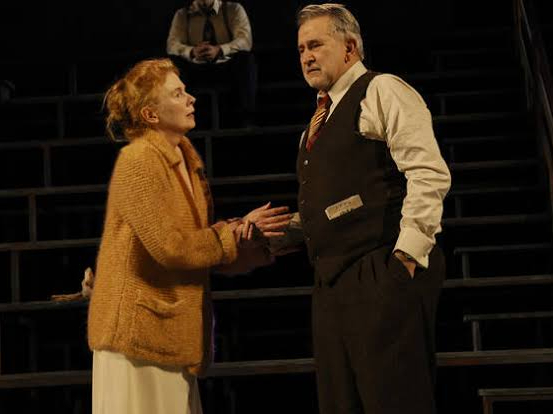
Willy Loman stands centre stage.
Behind him are the wooden bleachers of Ebbets Field where other characters sit in the shadows, like the dimly lit ghosts of all of Willy’s intangible pipedreams.
Somebody asks whether Willy is liked. He spins around, with uncharacteristic agility, points at his interrogator and proclaims that he is well liked.
For Willy Loman, a career travelling salesman, this is the highest praise. It’s what he has spent his career building. A reputation for being well liked. It’s the only thing he can hold onto. But is it real?
By the time we meet Willy, in the opening scene, his fabricated sense of self-worth is already venting through the cracks of the artifice he created. Now the walls are closing in on him. We, in the audience, have a fair idea how this story will end. There’s an unabashed spoiler in the title.
The 700-mile return trip from his home in Brooklyn to his potential customers in Boston is becoming too much for the aging Willy. He’s no longer paid a salary and is working for commissions. When Linda, his wife, asks him how much he made on his latest trip, he instinctively inflates the figure by one-third. It’s only when particulars are demanded that he fesses up. But Linda takes it in her stride. She’s heard it all before and is more concerned about which of the mounting bills should get priority.
Now Willy can’t sleep. He haunts the house in which he and Linda live and to which their two sons, Biff and Happy, have returned. He’s ranting and raving about past injustices.
But in his advancing despair there is still hope.
Biff and Happy! Perhaps they will be well liked as they forge their own paths. That will be his legacy. But is his faith in them as misplaced as his faith in the American dream?
Sublime Performances
This is the first time I have seen Death of a Salesman. After seeing two other Arthur Miller plays on the West End and Broadway – All My Sons and The Price – I jumped at the chance to see his most famous work. Indeed, one of the most revered stage-plays in the American canon.
But I was also attracted by the idea of seeing Anthony LaPaglia in the lead role.
I was not disappointed. From the moment LaPaglia shuffled onto the stage, sapped of energy and somewhat disoriented, in his ill-fitting brown suit and worn hat, he embodied Willy Loman. To my ears, his accent was spot on. He conveyed all of Loman’s despair, not just through his voice, but through his changing facial expressions and his body language. Bravo!
But LaPaglia was not alone on stage.
I thought Alison Whyte was terrific as Linda Lowman. She occasionally stumbled for the right words, just as we all do. And the way her voice cracked when she revealed to her sons the concerns she harboured for Willy was heartbreaking. Yet she never lost hope, right to the end. Even her closing monologue, following the salesman’s death, contained nuances of hope.
Josh Helman was compelling as Willy’s oldest son, Biff. I suspect it’s a difficult role to play. Biff inherited some of Willy’s low-hanging delusions. Yet he fights with both his father and his mother. That is, until the reckoning comes and he sees all his shortcomings in stark relief. Helman did a wonderful job conveying the changing tides of his emotional journey.
And Ben O’Toole did a good job inhabiting the role of Willy’s youngest son, Happy. In keeping with his name, Happy is the most optimistic of the quartet in the family, perhaps because he is the youngest and he is yet to be fully visited by the harsh realities of life.
At three hours, plus interval, Death of a Salesman requires a degree of endurance. But it is well worth the time and effort. This production builds on the play’s reputation for portraying the fragility of the American dream in all its squalid glory.
And, let’s face it, in this era of cost-of-living pressures, cancel culture and fraught politics, the American dream appears to be hanging from a very slender thread.
My sometimes critical eyebrows never dipped below a Caterpillar Arch as the play’s themes were developed and spiked to a High Arch as the drama reached its well-earned crescendo.
For more information on Death of a Salesman:


Leave a comment