HIGH EYEBROW ARCH – ⭐️⭐️⭐️⭐️
By Bram Stoker
Adapted and Directed by Kip Williams
The Dramatic Premise
Jonathan Harker is a newly minted English solicitor. His law firm has sent him to visit a client at his castle in the Carpathian Mountains in Eastern Europe.
The legal task at hand could not be more mundane; the routine conveyance of a house near London.
But little is routine when your client is Count Dracula…
It’s not long before Harker senses the paranormal. The carriage taking him to Dracula’s Castle is surrounded by wolves. His host declines to dine with him because he has already eaten. After he has retired for the night, Harker spots Dracula climbing down a vertical wall, head-first. And then there is the small matter of the three vampire women who try to seduce him in the bed where he lays.
Harker’s breathing is rapid. Which stands to reason, because breath should not be wasted when every breath could be your last.
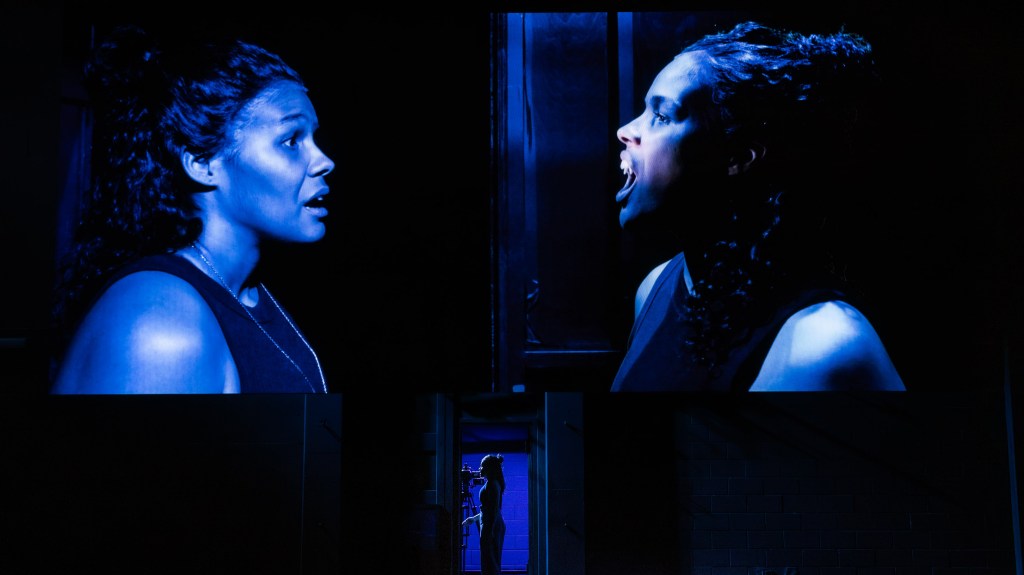
Photo Credit – Daniel Boud / STC
Meanwhile, back in England, Harker’s fiancée, Mina Murray is corresponding with her closest friend, Lucy Westenra. Lucy has received no fewer than three marriage proposals. After she makes her choice, Lucy and Mina holiday in Whitby.
But what is this?
Count Dracula has now landed on British soil and Lucy becomes the focus of his Vampirish lust for blood…
Will she survive? Will Dracula prevail? And what has happened to poor Jonathan Harker?
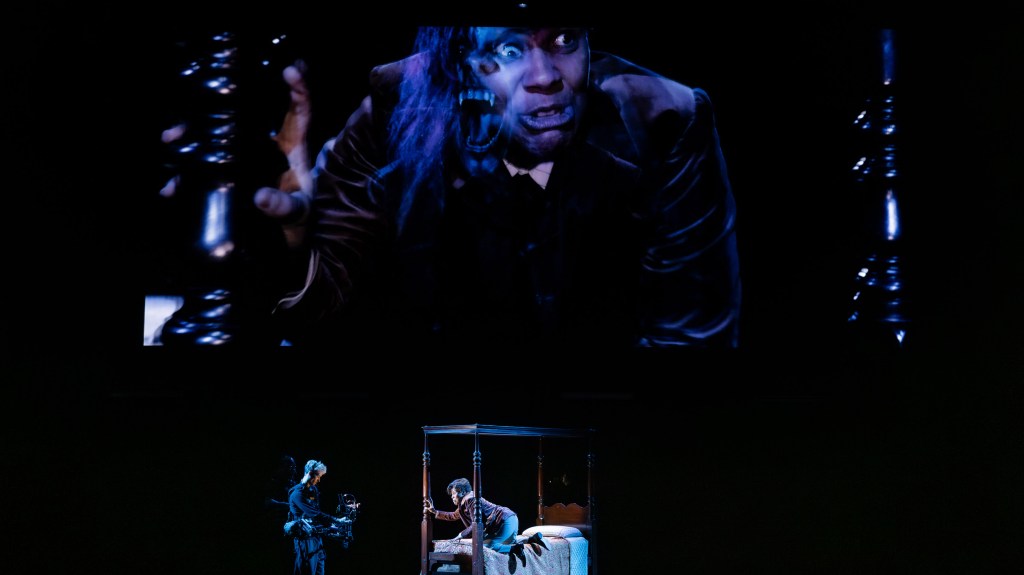
Photo Credit – Daniel Boud / STC
The Magic of Cine-Theatre
Jonathan Harker (played by Zahra Newman) has only just arrived at Dracula’s Castle.
He is looking in the mirror. He thinks he is alone. So he is, naturally, startled when Count Dracula (also played by Zahra Newman) suddenly appears behind him and starts talking.
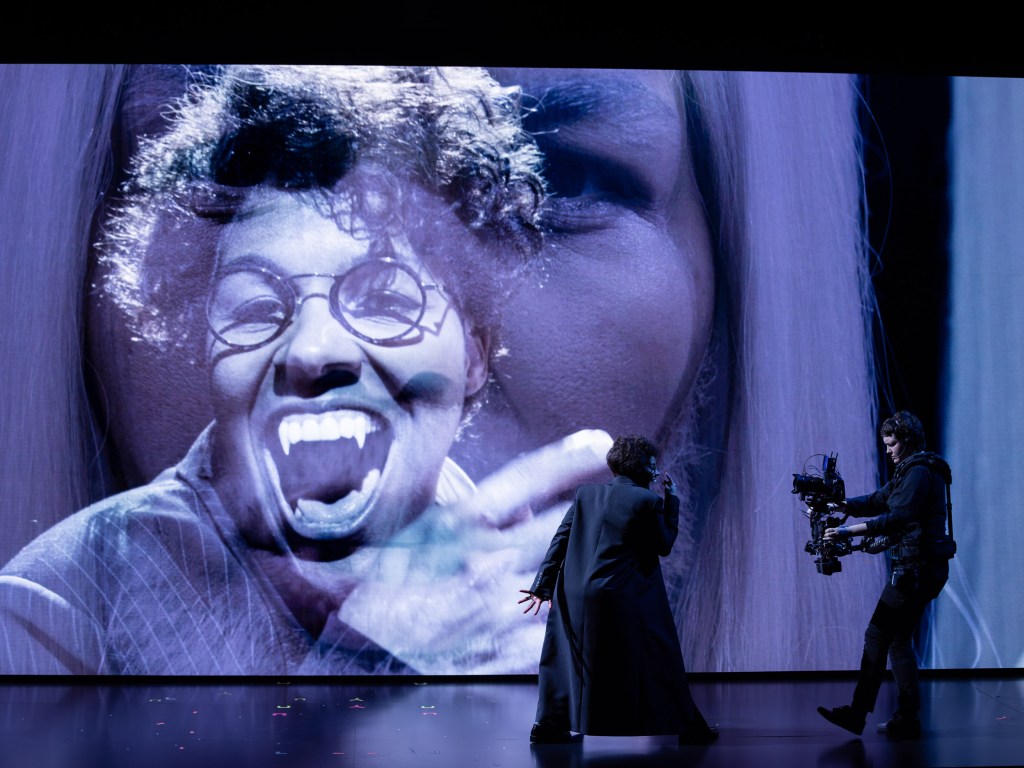
Harker turns to the camera-operator next to him and explains to the audience that he thought he was alone because the reflection in his mirror informed him that there was nobody else in the room. As Harker speaks, our eyes are drawn to the large LCD screen hovering above the stage. We can see a close-up of Harker’s brightly illuminated face on the screen. And, sure enough, Dracula stands behind him with crimson hair and canine teeth which project like daggers, a look of desire in his eyes as he peers towards Harker’s exposed neck.
Yet, those in the audience who dare to allow their eyes to move away from the screen and drift downwards to the figure on the stage will see that Harker does, indeed, stand alone.
Such is the sorcery of cine-theatre.
Such are the dark directing arts perfected by STC Artistic Director, Kip Williams.

Photo Credit – Daniel Boud / STC
This is the third in Williams’ trilogy of gothic cine-theatre productions (following The Picture of Dorian Gray and The Strange Case of Dr Jekyll and Mr Hyde).
As with the first two instalments, Williams combines three elements – live stage action, simultaneous screening and pre-recorded content – to create an intoxicating visual effect which is as thrilling as it is daring.
Adding to the visual impact are innovative camera angles and clever lighting design.
The result? A theatre experience like no other.
A Stupendous Performance
What adds to the glorious ambition of this production is that Zahra Newman plays every one of the several dozen roles in the story. Dorian Gray shared similar ambition. At least in Jekyll and Hyde, the load was shared by two performers.
Zahra Newman’s performance was simply stunning. At times, Newman narrated the story alone whilst embodying varied characters in the sweeping story. At other times, she interacted with as many as three pre-recorded versions of herself playing the central roles in the play.
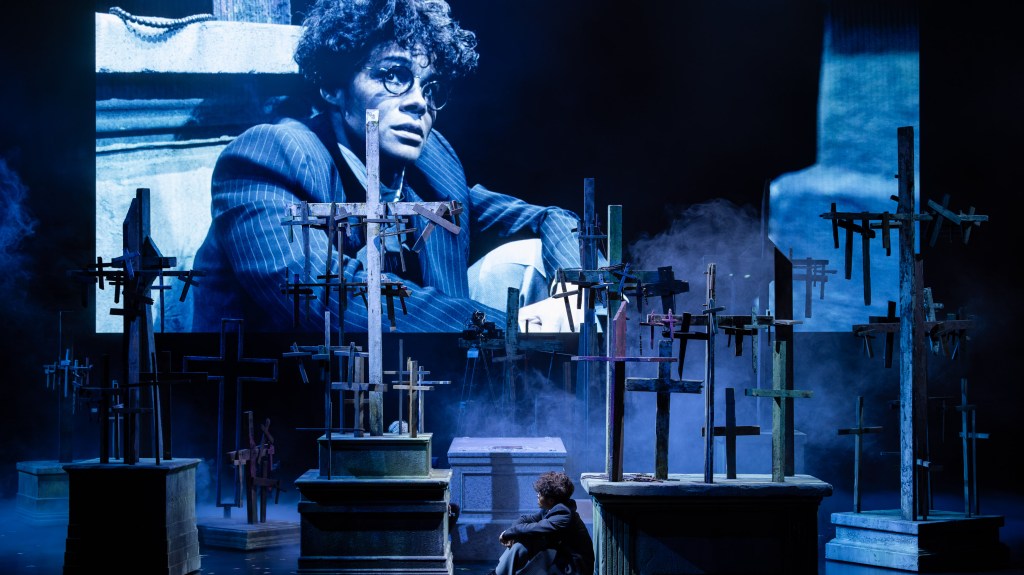
Photo Credit – Daniel Boud / STC
I simply do not have the vocabulary to explain the technical expertise Newman had to master to avoid the exercise descending into farce. Suffice to say that it was not just a matter of standing in the right spot and reciting the right lines. Newman also had to know precisely where to face, at any given time, so that she was interacting with the pre-recorded characters which we, in the audience, could see on the screen above her head. Up on the screen, Newman was conversing with other characters. Down on the stage, she was talking into a blank space.
All I can say is that the task of being in precisely the right place and looking in precisely the right direction for hundreds of interactions over a two-hour period must have been monumental. From where I sat in Row C, however, Newman never once got it wrong.
Ultimately, this was theatre at its most thrilling and its most daring. My eyebrows were elevated to a High Arch throughout.
For more information on Sydney Theatre Company’s production of Dracula:


Leave a comment