SUPREME EYEBROW ARCH – ⭐⭐⭐⭐⭐
This Man Can Talk!
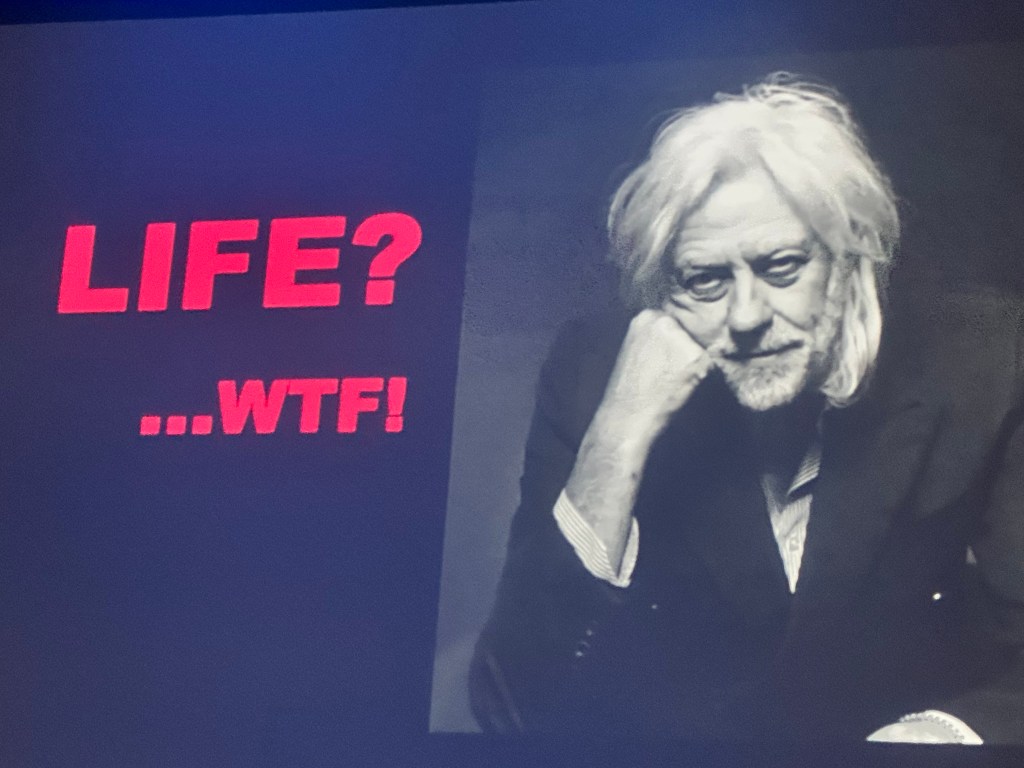
Sir Bob Geldof is pacing up and down the stage. He’s wearing a black t-shirt, denim jeans and a suede jacket. If a comb has made its way through his long white hair, it’s not obvious. But his equally white beard is well maintained.
Geldof suddenly turns on his heel and paces back in the other direction. Though he’s been at it for over two hours, the person manning the lights fails to anticipate his turn and has to make a quick correction to keep Sir Bob in the spotlight.
Geldof has been speaking for two hours and fifteen minutes without a break, his manic energy defying his seventy-three years. We’ve heard about his upbringing in Dublin, we’ve heard about how his father wooed his mother by challenging his mother’s fiancé to a boxing match (and won), we’ve heard about this aimless youth and how he stumbled into being a pop star, we’ve heard about how he wrote I Don’t Like Mondays following a school shooting in San Diego. And we’ve heard plenty of expletives.
But the time has passed quickly because Sir Bob Geldof knows how to engage an audience.
Now Sir Bob’s breathless narrative has reached the mid-1980’s. He’s describing his sense that his best years are behind him. He’d just written a good song but it wasn’t a hit. The Boomtown Rats may have lost their relevance. He’s only 32 years old…
Then, one gloomy October evening he sits down with Paula Yates and their young daughter to watch the 6 o’clock news. A news report about “a biblical famine” in Ethiopia is about to change his life.
Bob Geldof and Me
I was eleven years old when the Boomtown Rats released I Don’t Like Mondays. At that age, I was listening to 2SM a lot and was just getting a sense of what music I liked and what music I didn’t. And that quirky little song by that quirky little Irish band about a protagonist who prefers the weekend certainly resonated. It would be years later before I understood the true story hidden in the lyrics.
Five years later, I – like so many others – was disturbed by the images of starving children in Africa. Do They Know It’s Christmas was released in the same month my father’s job saw us move to Japan for several years. And it was in Tokyo, one glorious mid-summer’s night, that I stayed up until dawn to watch Live Aid from Wembley in London and JFK Stadium in Philadelphia. The next morning I headed straight to the local record shop in Komazawa to buy as many Queen albums as I could find, together with some U2, David Bowie and Mick Jagger. I already had plenty of Dire Straits, Bryan Adams and Simple Minds in my collection.
As a 16-year-old in 1985, Live Aid was one of those seminal moments of my youth. Both the bold ambition of the cause and the sheer excitement of the occasion have stayed with me forever. To this day, I listen to the concert regularly.
It should come as no surprise, therefore, that my recently published novella, Sidebottom’s Reach, starts the morning after Live Aid and the concerts provide both an historical backdrop for the story and a surprising connection to the climax.
What My Eyebrows Told Me
Listening to Sir Bob Geldof essentially tell his life story was a delight. As he himself prefaced, you can’t understand the man, and the man’s motivations, until you see where he came from. Until you see the events which shaped him.
A narrative exists that Bob Geldof was a scruffy, washed-up, rock-n-roll-has-been. A useless git. Before he suddenly changed path and re-generated as Saint Bob. I don’t think either element of that narrative is accurate. Geldof is not a saint. Far from it. But his response to the Ethiopian famine was not an aberration either.
Sir Bob Geldof is a man who simply won’t sit still when he thinks there is something he can personally do to ease the suffering he sees in the world. For that, he has my utmost respect and a Supreme Eyebrow Arch.
For more information on Sir Bob Geldof’s tour:


Leave a comment