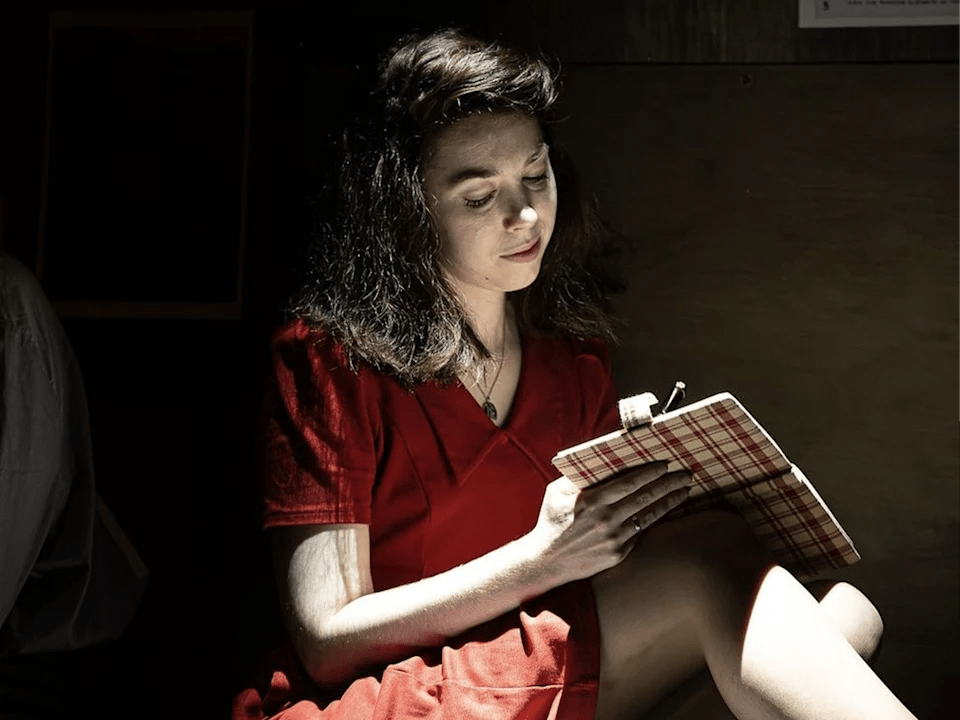

The Drama
Otto Frank is a cautious, but worried, man.
It’s 1942. It’s almost 10 years since Otto foresaw that life in Hitler’s Germany would become intolerable and he uprooted his young family and re-settled in Amsterdam.
All he wanted was for his family to be safe and for him to be able to run his business selling jams, spices and seasoning.
But we’re deep into the Holocaust now. Every aspect of a Jew’s life is governed by antisemitic laws. He and his family have to wear bright yellow Stars of David on their clothing. And the crowded cattle trucks are heading east with greater frequency.
So, once again, Otto must act decisively in the protection of his family.
But Otto has a plan. He’s sealed off an annex attached to his warehouse. A bookshelf disguises the door to the hiding place.
Now Otto is standing centre-stage. In a calm and measured voice he explains the new domestic reality to his wife, Edith, and his friends, Hermann and Auguste Van Pels.
They must remain completely quiet during the day because the warehouse below them remains in operation and it’s imperative that the workers do not hear them. They must not talk. They must remove their shoes and move about as little as possible. And they can not use the WC because the workers will hear the water draining through the pipes from the floors above.
If their hiding place is uncovered, they may soon find themselves on one of the cattle trucks heading east, towards a profoundly uncertain future.
Yet into this world, fraught with danger, skips thirteen-year old Anne Frank. Her older sister, Margot, and the only Van Pels child, Peter, trudge in behind her.
Will Anne retain her sense of girlish idealism? As the months in hiding turn into years, will she still see the innate good in people? And what will become of the diary she labours over? Will the words she writes cause her to be remembered after she is dead?
What My Eyebrows Told Me
I read The Diary of Anne Frank about twenty-five years ago. I remember finding the young girl I met in those pages quite endearing. Anne was a good writer. Through her writings, I had a vivid image of life in the secret annex. That Anne did not even live to see her sixteenth birthday is an unspeakable tragedy.
The problem with the stage play is that I already knew the story. Even those who had not read Anne’s diary were probably aware of the basic plot and the cruel outcome.
I would have liked to hear more words from the diary rather than imagined confrontations between the characters.
I was, however, gratified that these words – which resonated with me when I read The Diary of Anne Frank – were given appropriate prominence:
“I want to go on living even after my death! And therefore I’m grateful to God for giving me this gift, which I can use to develop myself and to express all that’s inside me.”
The challenges of telling a story which is so well known in another form, notwithstanding, I enjoyed the stage version of The Diary of Anne Frank.
My eyebrows remained fixed in a Caterpillar Arch.
For more information on The Dairy of Anne Frank:


Leave a comment