
Travel Anecdotes
I am fortunate to have seen the world with Huckleberry B. There’s so much world to see.
Together we have traversed every line of longitude multiple times. We’ve ventured 78 degrees north, to Svalbard, and 69 degrees south, around the Antarctic Peninsula.
We’ve swum below sea level, at daybreak, in the Dead Sea. And we’ve trekked, for a week, 4,000 metres above the level of the ocean, in the Himalayas.
We’ve ridden donkeys in Santorini and swum with sea lions around the Galapagos Islands.
We’ve stumbled along a forbidden, dilapidated section of the Great Wall of China and we’ve explored a sub-terranean section of Herod’s Wall in Jerusalem.
We’ve seen the Pyramids in Cairo, the Colosseum in Rome, the grasslands of Tanzania and the deserts of Radi Rum.
We’ve sailed the Pacific, Atlantic, Indian and Great Southern Oceans. We’ve driven to the Cape of Good Hope and rounded Cape Horn in a cruise ship. We’ve visited Nordkapp in Norway, with 99.9 percent of Europe’s population south of where we stood.
We’ve negotiated the locks of the Panama Canal and cruised through the Suez.
We’ve travelled in both directions along the Danube. We’ve sauntered along the Mekong.
We’ve been dwarfed by fjords in New Zealand, Alaska and Norway.
We’ve tandem sky-dived in Wollongong and ziplined in Mexico, Costa Rica and Panama.
We’ve flown in a hot air balloon above the stupas of Myanmar, landed in a helicopter on a glacier in Alaska and flown in a small plane over the Beagle Channel, near Ushuaia, in Argentina.
We’ve seen countless theatre productions on Broadway and the West End. We’ve watched Test matches at Lord’s.
We’ve had lunch, at dusk, during a Swedish winter and we’ve sunbathed beneath a midnight sun in Norway. We’ve slept through aurora borealis in Iceland and successfully chased aurora australis in a chartered plane between Australia and Antarctica.
We’ve stood were the great escapers exited tunnel Harry at Stalag Luft III and traced their footsteps through the woods. We’ve walked along the trenches of Gallipoli.
We’ve fallen ill in Kuala Lumpur and Sao Paolo. We’ve been denied entry to the Taj Mahal. We’ve been pickpocketed in Buenos Aires. We’ve lost our luggage in Johannesburg.
And, along the way, we’ve collected a bunch of life-long friends, spread across the globe.
Our country count rests at seventy-three.
And, here, below you’ll find a collection of travelling anecdotes we collected whilst on the road.
JAMALA MADIKWE | October 2019
Three Lions Sleep
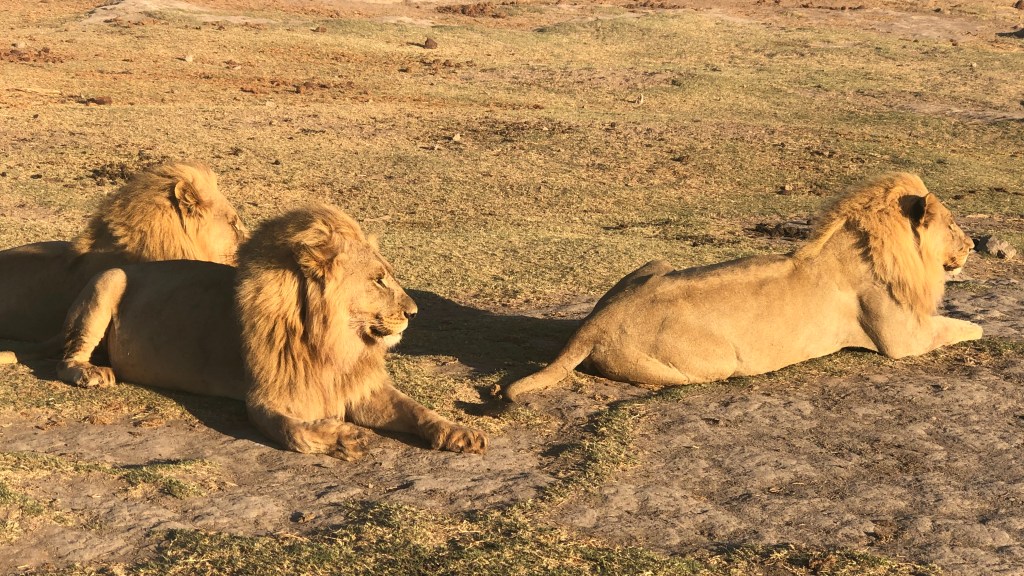
The three lions – all brothers – lay flat on the sandy ground and, extending their necks, began lapping water into their mouths.
Their bellies were full following their successful overnight hunt, but they were tired and thirsty.
Our open safari truck trundled along the road, towards the remote water hole, whilst the three brothers sated their thirst.
“Lions,” KG yelled, “Three of them!”
Huckleberry B and I followed our guide’s directive finger but all we saw was dust and boulders.
“Do you see them?”
“No…”
“There! By the waterhole!”
Suddenly, one of the ‘boulders’ began to move and we recognised the muscular hind-quarters of a male lion. I heard Huckleberry B gasp.
With a confirmed focal point, the other two lions became visible against the sandy background.
First one brother, then the next, raised their large heads and looked cautiously around. They appeared completely unconcerned by our proximity. KG explained that the game rangers had tracked these three brothers since birth. He knew them well. They each had names.
“See how their manes are a light orange,” KG explained, “that’s because they are young; about four years old. Their manes will grow darker with age.”
Their thirst quenched, the lions focussed their attention on their next mission: finding some cool shade in which to sleep.
My excitement was unrestrained as the trio rose to their feet and padded along a lazy path directly towards our position in the open truck. The lead lion paused momentarily, looked briefly in our direction – his yellow eyes imbued with a dull, primal malevolence – before continuing his slow walk.
I glanced at KG to gauge whether he was troubled by the lions’ approach and drew some comfort from his casual, slumped position across the steering wheel, replete with unconcerned ambivalence.
“They are so full,” KG marvelled, “they killed a Cape Buffalo yesterday.”
The three brothers were now within snarling distance. Surely, we were now in mortal danger. If just one of the lions decided to launch himself at our vehicle, there would surely be insufficient time for KG to activate the vehicle’s ignition and hurtle away. Yet our guide exhibited no indication of anxiety. Against my innate instinct, I decided to trust both his knowledge of the warning signs and his capacity to judge them. I did, however, glance over my shoulder to satisfy myself that a fourth brother was not stalking our exposed rear flank.
One after the other, the first two lions entered the long shadow cast by our vehicle and executed a controlled fall to a resting position on the ground. They lay down in instalments. We were so close that we could hear the air expelled from their lungs as they slumped onto their sides.
Now the third lion entered the shade. Huck B and I exclaimed with justified joy as he rubbed his long left cheek against the maned head of his sleeping sibling with abundant brotherly affection.
I marvelled at how tame the lions were; before I remembered that – within the last 12 hours – they had stalked a Cape Buffalo, chased it down, ripped its guts from its stomach with their unsheathed claws and, with their long, savage teeth, ripped apart its flesh.
They may have been given names, but they still relied on their hunting skills to survive. And they hunted in a pack.
But, as the burgeoning African day warmed up, all they now desired was some shade in which to sleep.
An Elephant Bathes
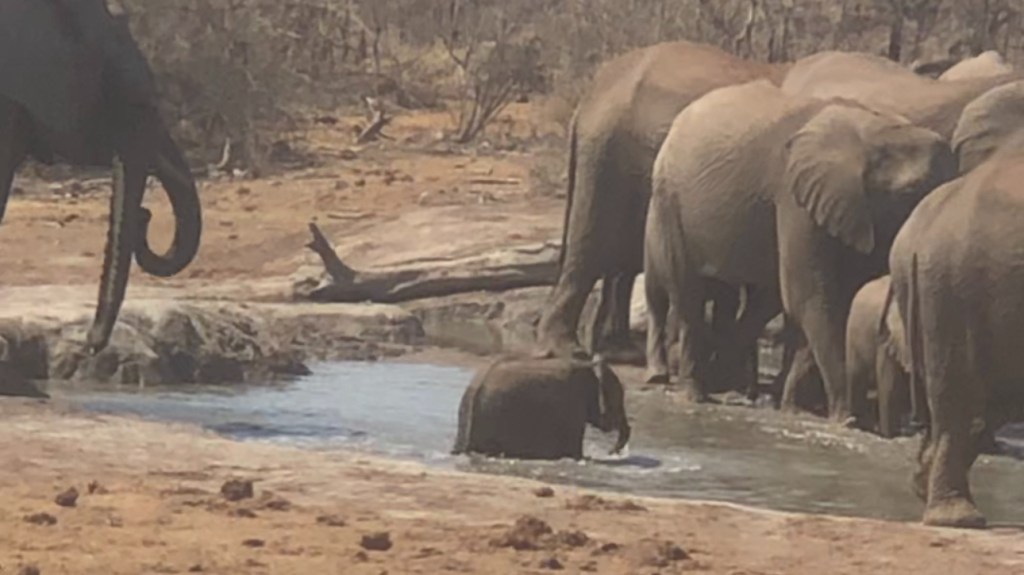
As the imposing relatives in her herd stood in the waterhole, sucking water into their trunks and depositing the refreshment into their mouths, the elephantine infant stood uncertainly on the shallow bank trying to decide what to do.
In the meantime, I sat on the open deck of Jamala Madikwe and, with supreme purpose, impaled a slice of pork sausage onto my fork and began to chew.
The baby elephant finally found her courage and trotted into the water, before unceremoniously tumbled backwards onto her hindquarters, her big ears flapping in the sun. She found her feet again and skipped forward energetically – with an awkward, ungainly gait – towards one of the adults. When she got there, she looked upwards, craning her neck uncomfortably, and beamed with both joy and pride at her mother.
Suddenly, an adolescent elephant crouched down on his front knees and unceremoniously toppled over, flopping into the shallow water, and rolling joyfully in the mud.
It was the signal for others to follow.
One by one, huge mounds of grey, flabby flesh were rocking back and forth, covering themselves with mud.
Back on the open deck, I sipped my cappuccino and Huckleberry B munched on some toast. We turned to each other and smiled as the African sun glistened on our sunglasses.
The Lone Rhino
A man-made water hole is positioned at the top of a hill in the north of Madikwe.
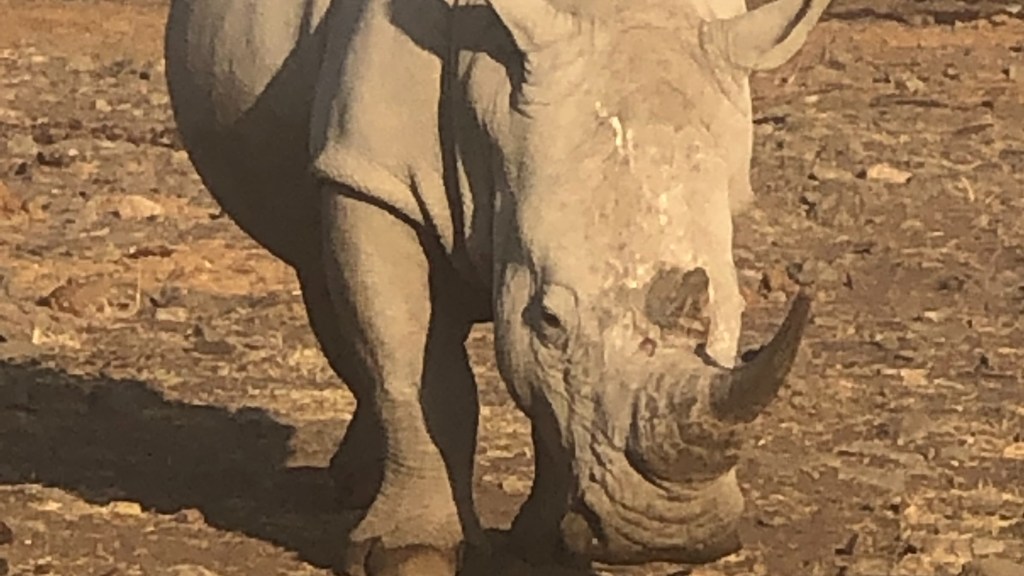
As our open truck bounced up the rise, towards the fast setting-sun, the rhinoceros came into view. He was standing perfectly still, by the water hole, with his lips against the water.
I was thrilled. Early in the safari, I had announced that we failed to see a rhino in Tanzania, so that was one of my ambitions.
The idiosyncratic beast was much larger than I had expected. He began to plod slowly to his left, his long-horned head swinging low to the ground, in search of grass. His horn was almost as long as his stubby legs and out of proportion to his comically small ears and squinting eyes. Don’t get me started on his cute tail, which curls when placed upright! What an odd-looking animal!
Now the rhino was walking slowly, but purposefully, towards our truck. Once again, I took my cues from KG. By now I had learned that if he was not concerned, then I should relax. I surmised that if KG ever exhibited signs of alarm, then it was time for me to panic!
There was no need to worry. KG was right. Again. The rhino swung his head away from us and sauntered off towards our right. In time, he found a hollow in the ground and he settled down to rest for the night.
Soon it would be time for us to do the same, so KG headed back to Jamala, where a delightful dinner awaited.

JOHANNESBURG | October 2019
Cotswold Gardens Commotion
I thought it was a buzzer. Honest I did.
Huckleberry B and I had already settled into Cotswold Gardens – a pleasant B&B in Rosebank, an affluent suburb in Johannesburg – and it was almost time for dinner.
We had been warned not to brave the local streets after dark, the affluence of the locale notwithstanding, so Huck B sourced some tasty-looking local burgers which “Mr Delivery” would motor to our front gate.
Only problem was that the website wanted to send a “one-time passcode” to our mobile and we didn’t have a local SIM card.
So, my quest was to find Anne, the nice lady who was minding the B&B for the owner, and ask her whether we could use her mobile. But I couldn’t find her.
I knocked on the door to her office, but there was no answer. I tramped the hallways, but I couldn’t see her. I checked the (lovely) garden, but she wasn’t out there either.
Returning to the office, I spotted a button immediately adjacent to the door frame. It was right there. And in the exact location one would expect to find a device to summon the manager when you needed to speak with her.
So, with myopic optimism, I raised my right hand and depressed the buzzer with my index figure.
Suddenly, the hallway was vibrating with a painful pulsating noise which made my heart thump in my chest. C’mon cats and shake your hats; I mean [that] joint was jumping!
With bustling alacrity, Anne emerged from a door at the end of a dark hallway and scurried towards me. I could see the fear in her eyes.
With shame in my heart, I raised my hands so that my palms faced her and started babbling urgent apologies, tripping over myself to explain my foolhardy act.
Suddenly the phone was ringing and, turning from me with a shake of her head, Anne trotted away to answer it. I heard her explain to the caller that a guest had accidentally pressed the panic button and that there was no cause for alarm. Literally!
Once Anne had entered the code to shut down the awful racket, I apologised some more, with impressive repetition, before our host stopped me by assuring me that all was well and I shouldn’t worry.
“I thought it was a buzzer designed to summon you,” I mumbled.
“Well, it worked, didn’t it?” Anne laughed before shuffling back to the seclusion of her room.
GALAPAOS ISLANDS | October 2018
A Mother’s Duty
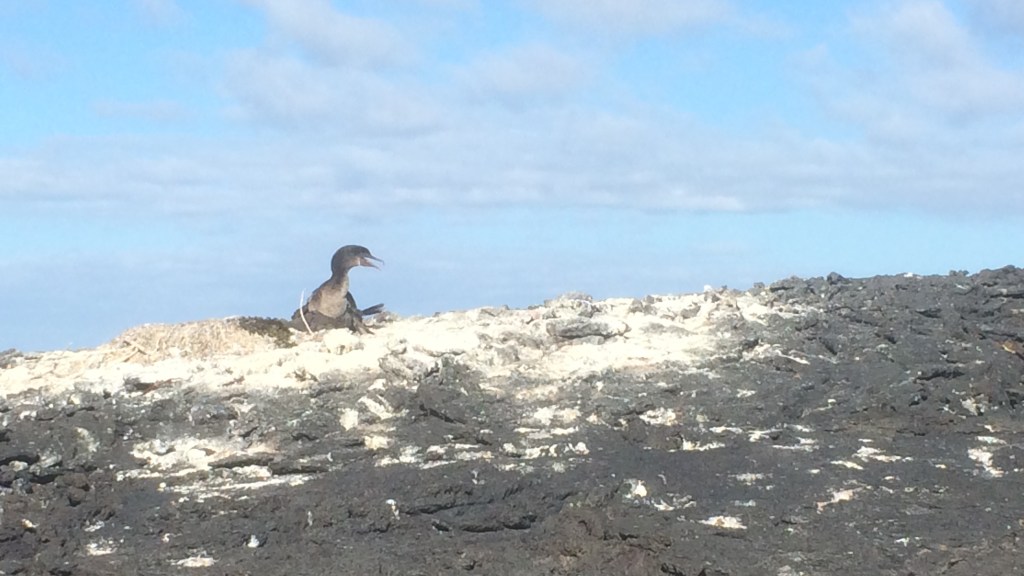
Denied the power of flight by natural selection and the complacency of her forebears, the Cormorant mother could do little to protect her infant other than stand in the path of the Hawke and plead her case though her high-pitched squeaking squeals.
Meanwhile, the Cormorant chick – oblivious to her mortal danger – continued her demands for re-processed food from her mother. So, in between delivering squawking jabs at the Hawke, the Cormorant mother returned to performing gyrating convulsions which would eventually extract food from her belly, up her long neck, out her beak and into the waiting mouth of her child.
Pending the successful regurgitation of food, the Cormorant chick extended her long, thin neck upwards towards her mother’s mouth and emitted wailing squeals of urgent, insistent, persistent demand.
In the Zodiac, which continued to hover nearby, the fascinated humans watched on as the drama unfolded. Some were recording the events on their cameras, while others preferred to witness nature take its inevitable course and simply commit the occurrence to memory.
Finally, the black Galapagos Hawke decided to act.
Neither we nor the Cormorant mother will ever know why, but the Hawke resolved to launch from its lair, swoop over the top of the Cormorant nest and – with a flap of its long wings – soar away across the mangroves in search of a more appealing target.
Mother Cormorant’s heart leapt as the Hawke propelled himself in her direction. She thrusted her domed head, upon extended neck, towards her adversary and squealed again, but was relieved to see the Hawke deviate upwards – rather than down towards her baby – and fly briskly, but safely, over her head.
The Cormorant mother swung her head – like an inverted pendulum – and watched the Hawke fly away. And then, with a relieved chuckle in her little round eyes, she convulsed one last time and delivered life-sustaining food into the hungry mouth of her darling Cormorant child.
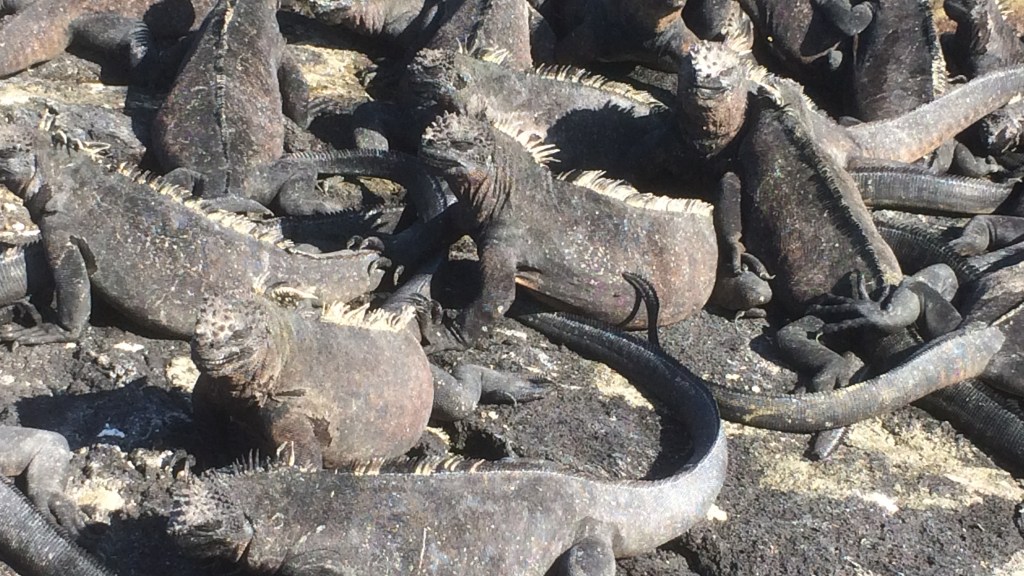
A Slow Day on Marine Iguana Rock
Irving, the Marine Iguana, nibbled on some algae and, with a kick of his back legs – and a paddling motion with his arms – propelled himself through the cold Galapagos water, his long tail swaying behind him.
He had been underwater for awhile now. Whilst his tummy was satisfied, his core temperature was dangerously low. It was time to emerge from the underwater smorgasbord and find a place to lie in the sun.
Popping his head above the surface, Irving looked around and saw a series of rocks he could easily climb. He caught a gentle wave before lizard-paddling slowly through the water; his small, pre-historic head bobbing up and down in time with his strokes. Reaching out with his clawed hands, he started to scale the lava rocks.
Soon enough, Irving was sauntering languidly across the black headland, between light-footed red crabs and lazy grey sea lion, towards his friends on higher, more sun-blessed ground.
“Hi there, Isaac,” Irving muttered to his friend, “what are you grinning at?”
“Oh! Am I grinning again?” Isaac replied, barely turning his head to greet his mate. “Igor over there just told me a really dirty joke about a penguin, a lava lizard and a blue-footed booby. You should ask him to repeat it; it’s a good one!”
“Okay, I will,” Irving nodded before turning his back to the sun and standing perfectly still, “but first I need to get me some heat; I’m ectothermic, y’know”.
“So am I,” mumbled Isaac.
“We all are,” grumbled Igor in the distance.
So, Irving flattened his body against the warm lava rock and splayed out his arms and legs. The morning sun pounded down in pleasing pulses open this back. Irving smiled in limitless, timeless pleasure.
Meanwhile, Isaac was already approaching his target temperature, so he turned and faced the sun; his arms straightened in a brace position and his head raised proudly in still, silent worship of the sun which emblazoned his face.
“Here they come again,” whispered Isaac out of the corner of his mouth.
“Humans?” asked Irving without moving his head.
“Yes,” Isaac replied, “they’ll stop and look at us for a while before walking on by.”
“Okay”, said Irving lazily as he snorted out a wad of sea salt through his nose, “I don’t know why they are so fascinated with us.”
After the humans had gone, Larry the Lava Lizard scurried up to Isaac.
“Hey Isaac,” Larry chirped, ”I see you’re attracting some tasty flies again; can I climb on you back to catch ‘em?”
“No worries,” Isaac grumbled, “you can sit in my head for all I care”.
And so Larry scrambled up Isaac’s parched, leathery flank, before traversing his neck and tip-toeing carefully past the spines on the crown of his small head. Then he lay in wait for the flies to come.
“Well, I think I might go for a swim,” Igor mumbled before setting off with barely constrained lethargy down the lava rocks, towards the water; one deliberative and well-considered step after the other.
“So, what your plans this afternoon, Isaac?” Irving asked his buddy.
“You’re looking at it,” replied Isaac out of the corner of his mouth; a mouth fixed in a grin rendered evil by the sublime joy of basking in the thermo-therapeutic sun.
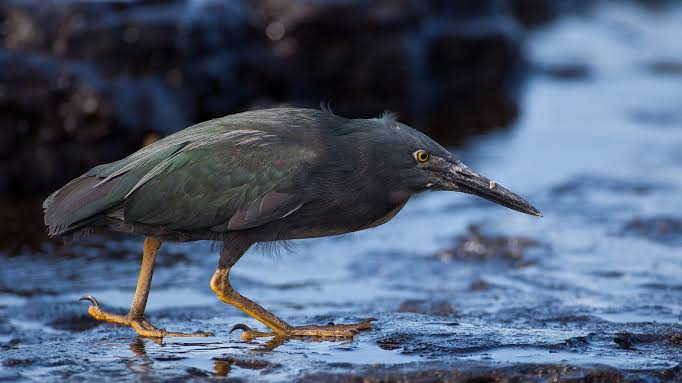
The Hunting Pose
The Galapagos Lava Heron stood quietly upon a rock – in the inter-tidal zone – biding his time as though prepared to wait an eternity.
The only discernible movements were the wind fluttering the Heron’s mohawk and the furtive darting of the black pupils encased within his orange eyes. Proud and attentive, the Heron awaited his chance.
Even the humans standing nearby failed to distract the Heron from his mission.
Suddenly, the Heron saw the small fish swimming towards him!
Gracefully, the Lava Heron crouched into his hunting pose; his back horizontal to the ground and his long beak pointing like an arrow towards his prey. But the fish noticed his change of stance, intuitively sensed the danger and swam away.
The Heron stood upright again and surveyed his target zone. Though hungry, he retained his patience; and his vigilance.
Finally, some more fish sauntered, unawares, into his killing zone. The Lava Heron crouched again into his hunting stance and slowly, ever so infinitesimally slowly, he placed one foot into the water and then the next: his eyes never moving from his target.
Suddenly, with breathtaking speed, the Lava Heron struck.
His beak darted, both sure and true, into the water and impaled the fish.
Swallowing quickly, the Lava Heron returned to his vantage point upon the rock and quietly awaited his next opportunity.

The Underwater Waltz
Matilda, the female sea lion, was enjoying herself.
Swooping through the water, darting between the rocks, both sleek and powerful, Matilda was exhilarated by own agility. A smile emblazoned her pretty face as she swam.
“It frustrates me so much,” Matilda thought to herself, “that I am so athletic in the water, yet so ridiculously clumsy on land.”
Matilda’s mind captured the image of herself rocking and rolling up the beach, pivoting on her back fins and struggling to make a fraction of the progress on land that she accommodates so easily in the water.
Rounding another submerged rocky outcrop, Matilda saw the humans swimming in their wetsuits.
“Oh my!” Matilda exclaimed. “Now it’s time to have some real fun!”
With a vigorous wriggle of her body and a thump of her hind quarters, Matilda the sea lion arrowed joyfully towards the swimmers. As she drew closer, she spotted a portly man with a bald head. He was hovering over some rocks, his flippers flapping infrequently, looking for a marine iguana feeding amongst the rocks, under the gentle waves.
Matilda swished up from the man’s blind spot and – just as she intended – gave him a shock as she suddenly emerged into his vision. Swimming away from the man, Matilda executed a perfect summersault and, now inverted, headed back directly towards his masked face at speed. Giving the man another shock, Matilda only deviated from her crash trajectory at the very last moment.
After another tight turn, Matilda glided back towards the swimmer – pausing as she drew alongside – and locking her beautifully lashed eyes on his.
“Chase me!” Matilda urged has she swam away.
I received Matilda’s unspoken message and, with furious kicks of my flippers, I headed off after her, executing a frenzied breast-stroke action as I went.
I had already swum with a large turtle and some cute little penguins on this morning dive, but I was longing to dance with a sea lion, as I had once before, a decade ago. I didn’t know whether I would ever get another chance to savour this sublime experience again.
Frolicking playfully in the water, Matilda performed three tight flips before heading back towards me. Once again, she directed her snout directly towards my face as she darted through the water. But this time, I was attuned to her playfulness and held her gaze as she altered her course, at the last moment, and passed me on my right-hand side.
Turning with clumsy and graceless agility, I headed after my frolicsome friend.
Matilda must have slowed down because I caught up to her with ease but, as I drew near, she turned on a dime and swooshed past me. I’ll be damned if she didn’t wink at me as she glided by.
So, I turned and headed after her again.
Matilda and I danced in the cold Galapagos water for five or more heavenly minutes.
It was only when I heard whistling from a zodiac which hovered nearby – followed sharply by a polite rebuke for not staying with the group – that I waved my friend a final farewell and, with profound joy in my boyish heart, resumed my search for a marine iguana feeding amongst the algae.
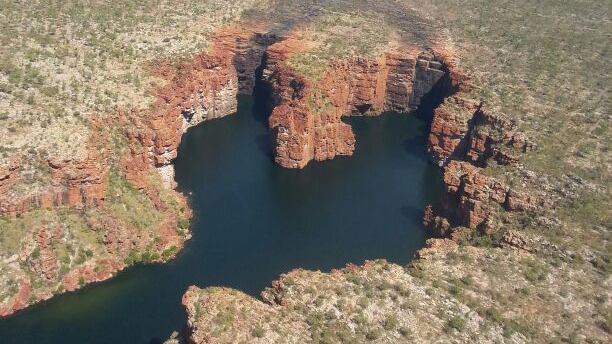
THE KIMBERLEY | July 2016
The Rock Painter’s Inspiration
Some 40,000 years ago, primitive inhabitants of the Kimberley stood at the sandstone walls of their habitat and depicted the world around them.
A rock wallaby; a dugong; a dingo; a turtle.
A Sharman; a group of men; a woman lying down (symbolising her death); something that looks an awful lot like a boat made from reeds.
Early morning, Newman, the gregarious chopper pilot from Auckland, transported M and L – whom we met the night before – together with Huckleberry B and me to a remote location amongst the scrub. Landing confidently in a clearing between some piles of rock, Newman guided us to several sites where the ancient artists had applied their pigments.
As Newman said, times must have been good. When you’re starving and food is scarce, your day is spent trying to survive. Only an affluent society has time for art.
We walked through the timeless art gallery, for over an hour, viewing dozens of rock paintings, whilst Newman entertained us with intriguing theories and genuinely funny quips. He explained how the painting techniques had developed over time.
Whilst we inspected a large number of paintings and even saw some human remains on a rock ledge burial site (perhaps 200 years old), one very large number dominated my thoughts; forty thousand years!
We were following the same path that an ancient man negotiated 40,000 years ago – a talented man who held an important position in his community; a story-teller. Or perhaps an historian or even an elder. An artist.
He carried his pigments and placed them by a sandstone wall with a pleasing aspect. Standing still, and ignoring any distractions around him, the man carefully painted an image on the wall. The image may have served any number of purposes; to record the sighting of an animal, to warn others about a danger or to claim the area as his own. Or, perhaps, he just painted for his own pleasure.
But I have a more primal theory. Maybe the primitive man simply painted to impress the woman he adored. Why not? Artists throughout history have been inspired thus.
We’ll never know the true purpose. But what we do know is that whilst the climate may have changed and species may have developed, the image that the ancient artist produced still remains.
Forty-thousand years.
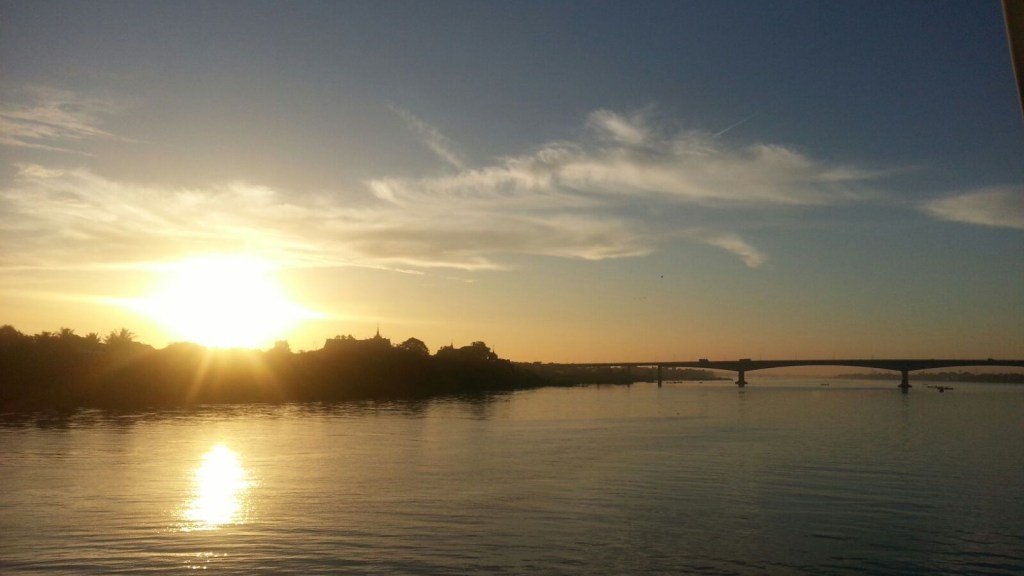
CAMBODIA | December 2015
Hanging On
After two relaxing nights at the Sofitel, at Siem Reap, we looked forward to our seven-day cruise on the Mekong River onboard RV Amadara. Our journey would see us travel from north-west Cambodia to south-east Vietnam, at a forty-five degree angle across Indochina.
During the rainy season, passengers boarding RV Amadara at Siem Reap enjoy a leisurely twenty-minute bus ride to Tonle Sap Lake before enjoying the perks of their vessel. We, however, were not boarding RV Amadara in the rainy season! Instead, we faced a six-to-seven-hour bus ride – along a mixture of one lane highways, corrugated dirt roads and tracks which may have been fit for a herd of Cambodian jungle goats – to a boarding point further downstream where the depth of the river could comfortably accommodate our boat.
It was about twenty-five minutes into our extended road trip when I knew I was in trouble.
I don’t wish to be too crude, here, in the description of my predicament. Let’s just say that I was confronted with the universal biological function whereby water is eliminated from the human body and my need to eliminate said water became more acute with the passing of time.
And only with the passing of a significant amount of damned time would a significant amount of dammed water be allowed, finally, to pass!
Our Cambodian guide explained that the locals referred to rest breaks as ‘happy stops’. There would be just two such stops on our long journey and the first was some 2.5 hours away! So, until then, I was subjected to bus-bound purgatory, without relief.
So, I just closed my eyes, gritted my teeth, and tried to think about something else. Anything but the Mekong River, or the Tonle Sap Lake…or waterfalls…or irritation systems…or dripping taps.
The violent shuddering of the bus over corrugations in the road did not help. Nor did the sight of several trucks spraying water onto dirt roads to settle the dust storm caused by the passing traffic. The offers of a water bottle to increase my fluid levels were akin to a cruel joke, which I swiftly rejected with an impatient wave of my hand.
Time passed slowly, like water seeping from a busted garden hose. I added that image to the list of things I really needed to stop thinking about. Together with water pistols and high-pressure cleaners and washing machines.
I tried turning my attention to the scenery. It was typically Indochinese. There were open green fields, mango trees, occasional villages with houses on stilts to avoid the floods. Damn! ‘Floods’; another thing to add to the list of things not to think about.
As the time for our first ‘happy stop’ limped closer, I began to fret. Was the 2.5 hour estimated travel time accurate? It seemed remarkably precise. Were we running behind time? The bus was delayed at several road works.
Suddenly, as though by miracle, the bus began to slow and turn off the road, before coming to rest at a market area. Was this it? Were we really there? Oh! Blessed relief!
“HeyIgottagotodamen’s“, I calmly said to Huckleberry B the moment the bus doors opened, clearly communicating my plight.
With that, I was out of the bus, darting across no man’s land and into the lavatory. Aaaaaahhhhh.

LISBON | October 2015
A Good Tart is Hard to Find…
Huckleberry B came to Portugal for one thing: Portuguese tarts!
“This is a private tour,” Miguel the Guide announce when we meet him outside the cruise terminal, “what are your objectives in Lisbon?”
“Portuguese tarts,” Huckleberry B gasped, “I want Portuguese tarts!”
“That is easy,” Miguel chuckled, “Anything else?”
“No, just tarts!”
After further discussion, we reached agreement with our extremely amiable host that he would take us on a tour of nearby Sintra, and the highlights of Lisbon, before launching an offensive on the tart store.
We made it clear that we had no interest in wandering aimlessly around big old houses, so we were happy to see the Pena Palace from the outside. Yes to tarts, no to palaces!
The drive around Sintra was delightful. We stopped for a small cheese pastry, dominated by cinnamon, at a local cafe, before negotiating the narrow alleys and lanes of the mountain town.
Lunch by the sea was equally delightful; wonderfully succulent, freshly caught sea bream with a side of unnecessary boiled potatoes.
Sightseeing and lunch behind us, tart time had arrived!
The recipe for genuine Portuguese tarts was developed, Miguel informed us, by monks in Concento des Jeronimod, a Monastery standing a short distance from where the Vasgo de Garma monument now stands. When the Monastery was forced to move, the ancient tart recipe was given to a family who established Pasteis de Belem in 1837.
According to both legend and the marketing blurb on the side of Pasteis de Belem boxes, the secret recipe is recreated to produce 20,000 hand-made tarts every day, employing purely traditional methods.
When we arrived, the queue was long but the service was fast. Soon we were walking away with 24 Portuguese tarts, or a mere 0.005% of the day’s production. Huckleberry B gave most of the tarts away, to friends we had made onboard and, more importantly, some of the staff like our butler, cabin stewards and the staff in Luminae and Murano.
Truth be told, I have never been impressed with Portuguese tarts. I equate them with scrambled eggs in puff pastry…
But the tarts produced by Pasteis de Belem tarts were extraordinary!
A good tart, these days, is hard to find; custard, pastry, the scrumptious kind!
LONDON | July 2015
We Come For the Ashes
It started as soon as we arrived.
Huckleberry B and I shuffled forward to the passport control counter at Heathrow – weary after a long journey – and were greeted with the customary question, “Why are you visiting London?”.
“We’ve come to watch the cricket at Lord’s,” my gallant wife replied.
The chubby immigration officer reclined in his seat as a cheeky smile migrated across his corpulent face and an insurgent chuckle sparkled in his eyes.
“I was hoping I’d process some Aussies today,” the insolent immigration man beamed, “have you heard the result from Cardiff?”
“Yep,” I sulked, “just saw it on my iPhone as I was queuing up.”
My inner voice, however, wondered whether the irritating immigration man really thought that it was his role to supplement his core duties with heckling the citizens of recently defeated sporting opponents.
“Lookin’ forward to Lord’s are we, mate, “our impertinent immigration irritant continued to niggle us, “lookin’ forward to another floggin’, are ya?”
“I knew this would happen,” Huck B grumbled.
“‘ere ya go,” our irrepressible immigration officer tossed our passports onto the counter, now laughing openly in our faces, “enjoy the Test!”
“Congratulations,” I muttered over my shoulder as I stalked off towards the baggage carousel, “you’ll be featuring in my travel journal.”
Gower Street
Huckleberry B had arranged a lovely room in boutique hotel called The Academy on Gower Street in Bloomsbury.
Just north of Covent Garden, our hotel was well positioned to allow us to walk both to Lord’s Cricket Ground in St John’s Wood, by day, and the West End theatres, (mostly) by night.
For eight glorious days we had a choice when we left The Academy of turning either left or right.
A left-hand turn would take us north to Euston Road which, to the east, becomes Marylebone Road. On this path, over Marylebone, through Regents Park, past the Islamic Centre, across Park Road, lies Lord’s Cricket Ground and ‘the Home of Cricket’.
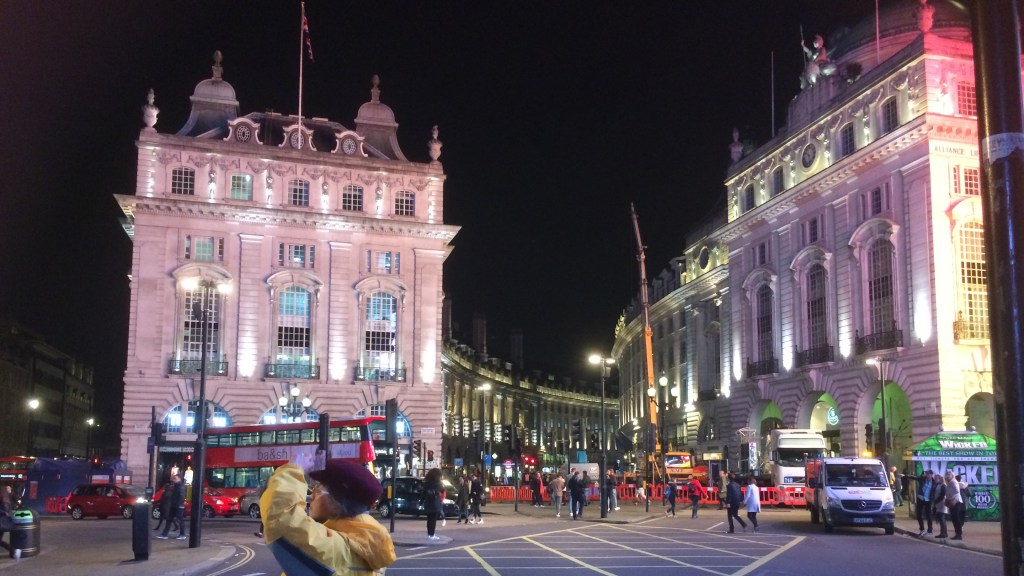
A right-hand turn takes us south to Shaftesbury Avenue where another right-hand turn took us to Leicester Square and Piccadilly, where the theatres flourish and bright lights glimmer.
On each sunny morning during the Lord’s Test, we set off with a spring in our step, hope in our hearts and joy in our souls.
On some days we turned left in morning but returned, late in the evening, from the right. This was not a week where we planned to get much rest.
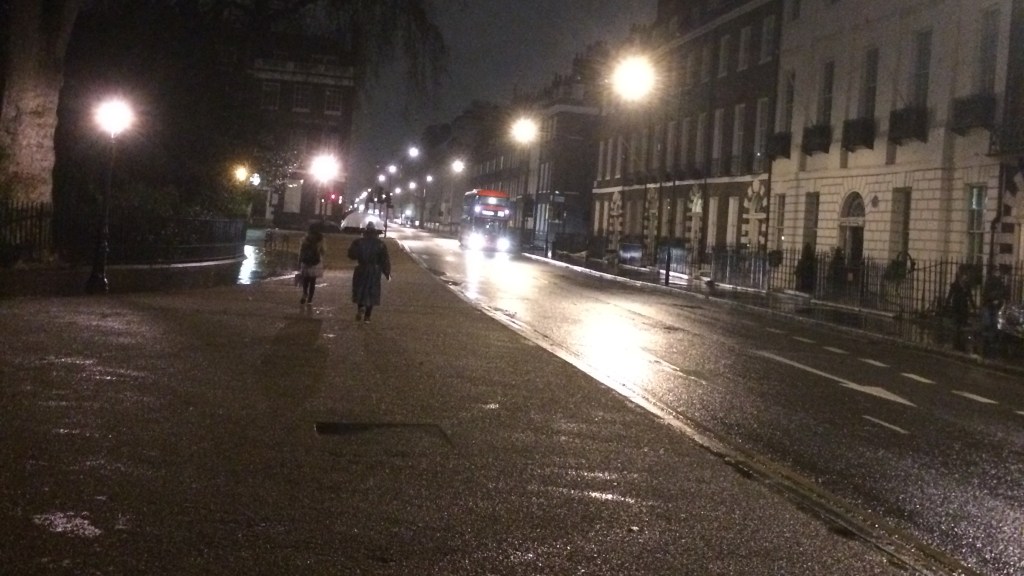
I came to love those evening walks back to our hotel on Gower Street. Tired, but quietly euphoric from another day well spent, my beloved and I would stroll from the bright lights on Shaftesbury Avenue and head towards the quiet darkness on the edge of Bedford Square. It was there that our London experience would become ethereal…
The warm glow of streetlamps cast shadows on the brown brick terrace houses which stretched to the horizon. Indistinct shapes lurked in the darkness. In my imagination, Sherlock Holmes walked ahead of us in his deerstalker hat, whilst Bridget Jones waddled towards us. Was that Mr Bean on the other side of the road looking at us quizzically? Was Dr Who about to step out of that telephone box next to the park? Surely that shadowy figure above us was a woman in an overcoat being transported by her own umbrella.
Oh, how we love London!
Will We Ever Walk This Way Again?
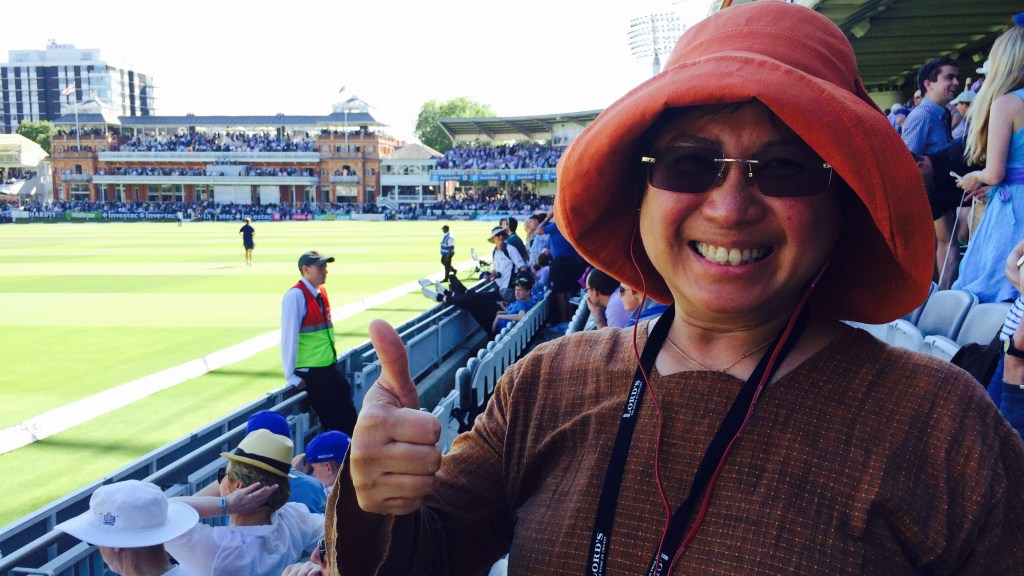
On that stunning sunny Sunday afternoon – English wickets tumbling, Englishmen around us grumbling – it slowly dawned on me that the Test was likely to end that day and our 5th day tickets would soon be relegated to the status of souvenirs.
It was a strange feeling; extreme excitement – as the Australians took wicket after improbable wicket, inflicting psychological scars as they went – mixed with a menacing melancholy because our adventure was coming to a rapid conclusion.
Test matches have ended early before at the Sydney Cricket Ground – my `home ground’ – but there has always been next year to look forward to. Who knows whether we will every have a chance to visit Lord’s again during an Ashes Test.
I began looking around, quickly trying to commit the entire experience to memory: the sights and the sounds and the way the trees behind the Edrich Stand stood proudly in the sun and the way the media centre hovering at the Nursery End, leaning forward expectantly like an immense slips fielder awaiting a catch, and the way the playing surface famously ran downhill from my right to my left and the murmuring of the well-mannered crowd and the apartment buildings on St John’s Wood Road peaking over the top of the Mound and Tavern Stands and the glory of the ever present Member’s Pavilion casting a highly critical eye over both the players’ techniques as well as their temperaments, as that grand old lady had done for over thirteen decades.
The way almost everything about Lord’s had exceeded my expectations.
And too soon it was over. Hazlewood bowled Anderson and the Australians embraced whilst the Englishmen trudged from the ground. Huckleberry B and I gave each other a fist pump before standing and applauding our heroic champions.
Looking around one last time, I wondered (once more) whether I would ever venture this way again.
TOKYO | October 2014
The Breakfast Club
A strange man was striding past our table.
Huckleberry B and I were enjoying our Japanese breakfast at the Westin Hotel – noodles, pickled vegetables and miso soup – when we simultaneously felt his presence.
The man was striding with too much purpose for the early hour. A curled wire ran from his ear, down his neck and disappeared under his jacket. For some reason he was speaking into his semi- clenched first. Yet his hand was empty…
We inspected the intruder. Tall, dark complexion, largely unshaven, nice suit. He reminded me of the guy from Miami Vice who isn’t Don Johnson.
Why was he here? To whom was he talking? Was he protecting somebody? Why did this buffoon suck at hiding in plain sight? Had he learned nothing from his training? Why was he making such an obvious spectacle of himself?
Suddenly an errant thought darted across my brain and embedded itself into my thought processes.
Maybe it is me they are after! Was my name on some kind of watch list? Could a member of the Komazawa Koen Bicycle Constabulary really hold a grudge for 30 years! Just because I played tennis against the wall of the secondary Olympic Stadium all those years ago when I lived in Tokyo! Really?
I watched in horror as my mind’s eye played out the scene.
Into the crowded restaurant peddled my nemesis – my own personal Japanese Javert – unsteady on his rickety bike as his feeble old legs struggled to turn the pedals over. Yet he finds the strength to dismount and hurl his bike dramatically to the ground before pointing at me and shouting so everybody in the restaurant can hear, “I’ve been chasing you across the years and now you are in my grasp!”
As I stand up to protest my innocence, the persistent policeman crosses his arms to form an ‘X’ and screeches, “I told you….NO TENNIS!”
Soon, two younger police accomplices hand me a bucket of soapy water and a sponge and haul me away, my head hung in deep shame. As they do, the aged, bike-mounted copper leans in and snarls triumphantly into my ear, “There is nothing on earth that we share; it is either Peter John or Javert!”
Travelling back, now, from Planet PJ to reality…
The incompetent security agent continued stuffing up his detail. During my flight of whimsical fantasy, he decided to take a seat in the restaurant. He slouched conspicuously in a booth and continued chatting into his empty fist. What the hell was he jibber- jabbering about, anyway?
Just then, a young woman returned from the breakfast buffet and walked towards his table. Was she the protectee? Was she a foreign Princess dressed casually for the morning? Or a pop starlet?
Our illusions were shattered when the inept, so-not-undercover agent, looked up at her (as she stood patiently in front of the table) and said loudly with dismissive disdain, “what you want?”
“Well,” she huffed, “You’re sitting in my seat…”
Worst security agent in the world!
Suddenly two more agents appeared. They, too, had wires in their ears and spoke into their hands. Now we knew why the first agent was so talkative. He was probably urging his colleagues to relieve him so he could get some “relief”!
“C’mon guys! Where you been? I’m busting!”
It turned out the protected persons were a group conducting a working breakfast in the booths behind us. We never did find out who they were. Huckleberry B observed a young lady, with a clip board, standing near the group who kept looking at her watch and was, perhaps, in charge of logistics. As bold as ever, my beloved simply asked her the direct question, “who are your group and why are they here?”
“We have some business meetings”, the young lady lied with a smile.
Unlike the security detail, this young lady was very good at her job.
BOSTON | October 2013
The Daily Catch
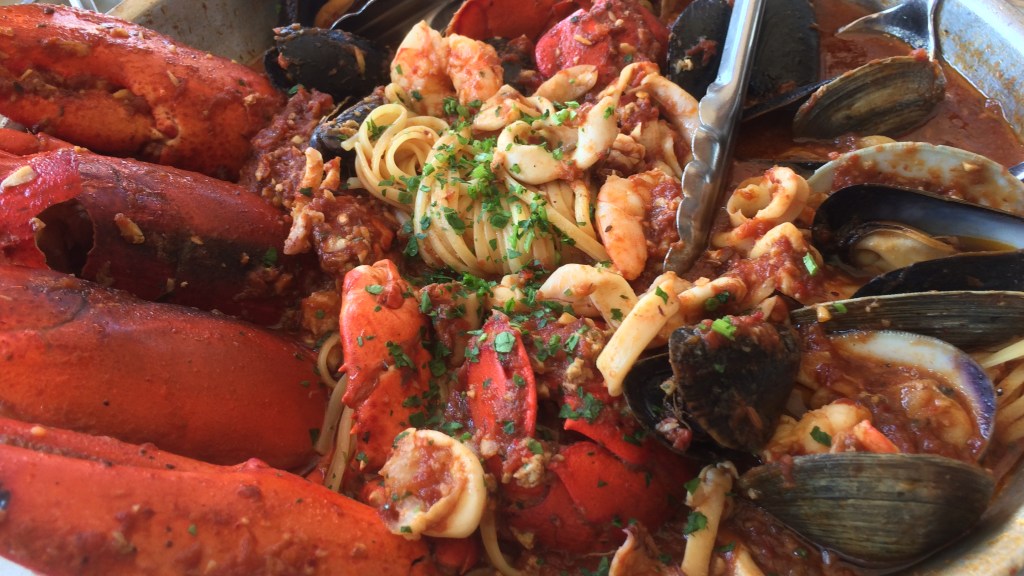
After Neptune’s we waddled a short distance to The Daily Catch on Hanover Street, opposite Mike’s Pastry (and some truly exceptional cannoli). This tiny restaurant was also recommended by R and P. And for good reason; it was extraordinary!
The quality of the food was not, it must be said, reflected by the ambience. As soon as we walked in, we were welcomed by a large, fresh faced Italian man, with short back and sides, a tidy beard, and curls atop his crown like the snakes of Medusa. When I say ‘welcomed‘, I should be more precise and report that he pointed first at us and bellowed (evidently in the form of a question) ‘two‘ before pointing to a table and directing: “in the corner‘. And when I say ‘table‘ it is more accurate to say that there was a platform erected over some form of enclosed shelf, with no leg room. In any event, we obeyed the commands directed at us and sat sideways in the cramped conditions.
R and P had recommended the Lobster Diavolo, so the choice was easy.
We told the bellowing waiter that we came on the recommendation of R and P and he demonstrated immediate recognition, “Yeah, I know ’em! They always come here straight from the airport! Hey, I’m Gino! Tell ’em I said hello!”
Looking around the restaurant, it was hard to imagine a more nondescript venue. There wasn’t even room for 20 guests. A full one quarter of the limited space was occupied by an open kitchen where a short order chef was hard at work juggling saucepans, pots, tongs and plates amidst a series of gas burners which periodically engulfed the array of saucepans in a blaze of open flame.
The fact that we were being offered Italian food by a chef who was obviously Asian was a bit of a concern. But he was wearing an azzurre blue cap emblazoned with ‘Italia‘, so that clearly compensated, in full, for the absence of any direct cultural connection between chef and cuisine.
Along the back wall ran a long stainless-steel sink where a young fellow with a mohawk was laboriously washing pots, pans and plates for immediate re-use as the evening wore on. As soon as one item was cleaned and dried another would arrive with a splash.
Meanwhile, Gino was taking drink orders by yelling across the tables from the far side of the restaurant and serving food by plonking saucepans overflowing with pasta onto the table, shortly followed by a pair of tongs tossed expertly into the saucepan without causing a splash.
After a time, the chaotic cacophony and the perverse percussion began to make sense. There was a baseline beat driving this madness!
Pot, Gino, Gino, plate,
Pot, Gino, Gino, plate,
Saucepan, tongs, Gino, tongs,
Saucepan, tongs, Gino, tongs,
Fire, water, Gino, plate, saucepan, tongs,
Fire, water, Gino, plate, saucepan, tongs,
Pot, Gino, Gino, plate,
Pot, Gino, Gino, plate.
Soon Gino was bearing down on us with an immense saucepan full to the brim with pasta, clams, prawns, red sauce and lobster. He delivered the saucepan to the centre of our table, without ceremony, and reminded us to say hello to R and P for him.
Now there was a new rhythm to out North End dining experience, superimposed upon the existing beat;
Pot, Gino, Gino, snap, slurp, Gino, Gino, clatter, chatter, Gino, Gino, snap, slurp…
The food itself was extraordinarily good. The whole experience was amazing.
We left with a wave – and more reminders to pass on Gino’s regards to our friends – and wandered back to our hotel, our bellies gorged and well satisfied.
ISRAEL | April 2013
King Herod’s Wall
We entered Jerusalem’s Old City through the Jaffa Gate, strolled through the Muslim Quarter, ignoring the pleas of shopkeepers as we went, before negotiating some steps down to the Wailing Wall.
Just as in 2007, when Huckleberry B and I last ventured this way, I was moved by the fervent spiritualism of those who meekly approached the Wall spoke to God and placed small pieces of paper, upon which they wrote prayers, between the rocks of the wall King Herod built over 2,000 years ago.
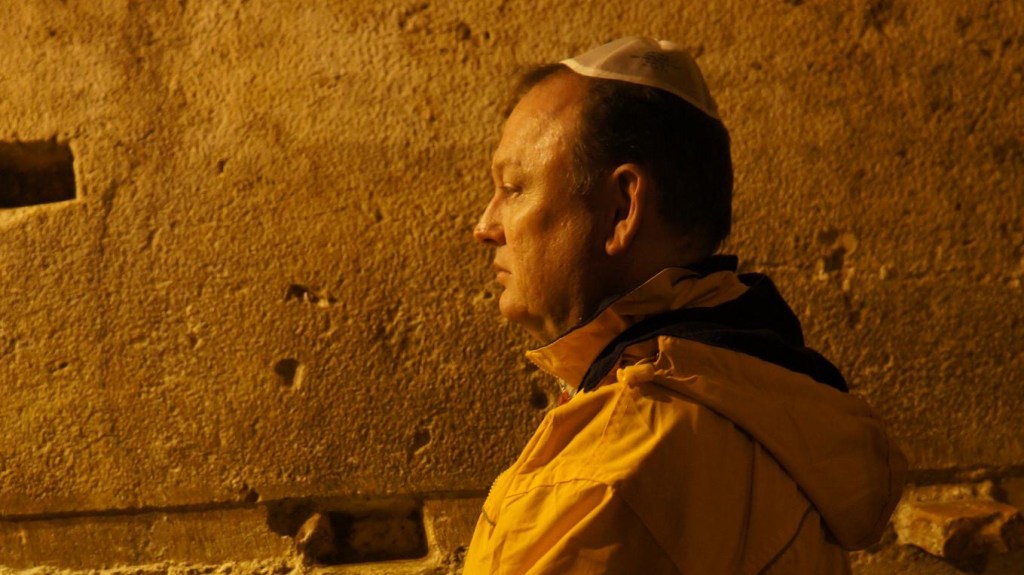
P and R – both Jews – had kindly invited us to join them on a tour of the ‘tunnels’ running adjacent to the Western Wall for a distance of 485 metres along Temple Mount. The experience was both intriguing and thrilling. I will never forget it.
First, a brief account of my understanding of history (with profound and sincere apologies should my summary include any misunderstanding or omit any important elements).
Temple Mount stands on the eastern side of Jerusalem’s old city. For those of the Jewish faith, the most sacred place – ‘the most holy of holies’ – is a rock on Temple Mount where they believe God gathered dust to create Adam. It was here that King Solomon built the first Jewish Temple over the rock where life began.
When the Babylonians invaded from the east, however, the temple was destroyed and the Israelites were driven from the Promised Land. Moses later freed his people from the Egyptians and, after surviving the desert, his son led the Jews back into Canaan.
In the first Century BC, King Herod vowed to rebuild the temple which the Babylonians had destroyed. But first he embarked upon creating level ground on Temple Mount by building solid retaining walls on each side and backfilling the interior. A small section of the western side of this support structure is now known as the ‘the Wailing Wall’ or ‘ Western Wall’.
Whilst Herod kept his promise to rebuild the Temple on Temple Mount, it was destroyed by the Romans. When the Muslims occupied Jerusalem during the era of the Crusades, they built the Dome of the Rock on Temple Mount at the point where they believe that Mohammad ascended to Heaven. The Muslim structure was built over the same ground once occupied by Solomon’s Temple; the holiest place in Judaism.
Thus was created the impasse which persists, without resolution, to modern times; two religions with fervent demands over the same sacred ground.
To this day, Jews worship at the Wailing Wall because it represents the section of King Herod’s Wall in closest proximity to the sacred rock on Temple Mount where their ancient temples once stood. The Jews still look forward to the day when the third – and final – temple will be built on Temple Mount.
We entered the ‘tunnels’ from a position close to the Wailing Wall. I have twice, prior to this sentence, placed the word ‘tunnels’ in inverted commas. I have done so deliberately. Whilst the path we walked was below current street level, we were actually traversing a series of arches and bridges which had been constructed during Herodian times to provide easier access to the temple. Essentially, these structures were built to fill in a valley at the south-western corner of Temple Mount. Centuries later, the Muslim Quarter was constructed over the archways.
And so we descended into the depths; down the stairs, across the bridges, through the archways and down still more stairs – striding along pathways centuries old – before arriving at the subterranean aspect of King Herod’s Western Wall.
When we arrived, our garrulous guide introduced us to an ancient wonder. Immediately in front of us, at head height, was an enormous rectangular rock – known as ‘the Western Stone’ – measuring some 13 metres in length and some 600 tons in weight. It was as heavy, we were told, as two fully laden jumbo jets. Nobody knows how the ancient Israelites lifted this immense rock into place.
Whilst still considering (and dismissing) various theoretical lifting methods in our minds, we four adventurers set off to walk north along the Western Wall to the far north-western corner. Along the way, we came across some women in earnest prayer. Our guide explained that whilst the Wailing Wall is the section of the exposed portion of King Herod’s wall closest to the ‘holy of holies”, the section where the ladies were praying was as near as a Jew could now tread to the sacred rock on Temple Mount.
One of the ladies was standing against the wall, her nose almost touching the rocks, whilst another sat opposite and recited prayers from a book. A third worshipper solemnly whispered to herself. None of them seemed concerned by our presence and continued in their quiet and dignified contemplation. I do not know whether they prayed for themselves, for their families or for their people, but the deep trust they placed in God moved me, notwithstanding my own lack of faith.
P & R were keenly aware that our thoughts have been – and remain – with a dear and cherished relative at home who is battling an insidious disease. P suggested that if we wished to pray for her, this was the ideal place to have a discussion with God. Both Huckleberry B and I turned to the Wall and spoke in silent accord. In that moment, it was the natural thing to do.
Our walk along King Herod’s Wall ended when we climbed a modern staircase at the north- western corner of Temple Rock, emerging once more at street level in the Muslim Quarter of Jerusalem’s Old City.
For Huckleberry B and me – two Gentiles – it was a privilege to walk along the Western Wall with our Jewish friends. We will be forever grateful for their invitation and earnestly hope that we did not intrude upon their experience of this most sacred place in Judaism.
EGYPT | April 2013
Sinai Shenanigans (The Calamitous Caravan to St Catherine’s)
We awoke just before 6am and the trouble started just after 7…
Our trip to St Catherine’s Monastery, on the Sinai Peninsula, will always be remembered for the world’s worst tour guide; certainly the most insipid and inept we have experienced.
Given that what follows is deliberately – and deservedly – defamatory, I shall obscure the identity of our guide by calling him ‘Ramesses the Turd”.
We told our tour operator, who sub-contracted Ramesses, that our ship would arrive at 6am. For reasons which are unlikely to ever be properly explained, Ramesses seems to have assumed that that meant we would somehow magically appear on the dock immediately and that we would be driving away from the port a couple of minutes past the hour. However, as anybody experienced with cruise ships would know, this was impossible. First the local authorities must come onboard and clear the ship’s passengers to come ashore before the tender boats start to operate. This all takes time.
We were well prepared and narrowly missed catching the first tender vessel to shore. We had invited the Bostonians, R and P, to join us for the day. The four of us caught the second tender instead. By this stage it was well after 7am.
After looking for our guide, we eventually found him 200 metres away at the gates to the port area. Other tour operators had successfully made their way down to where the tender boats arrived, but not Ramesses.
In any event – obviously keen to make a good first impression – the Ram immediately started bleating about how he had been waiting for us since 6am. We and the Bostonians just smiled and followed the guide to the waiting mini-van.
I think it’s fair to say that Ramesses immediately put R off-side, by addressing us as ‘guys’. Of sufficient age to be his mother, not to mention him being a complete stranger, she found this form of address overly familiar. We would have to agree.
What did pique our interest, however, was the presence of a third Egyptian in our vehicle. In addition to Ramesses and the driver, there was a man in a suit introduced to us as being from the Egyptian Ministry of Tourism. It later emerged, following direct enquiry from R, that the suited gentleman was armed with a semi-automatic weapon! He was more than happy to show it to us upon the barest hint of a request. In fact, the way he waved it around with an uncomfortable degree of relish was somewhat disturbing. I remain unsure whether his presence, and his armoury, made me feel more secure or less!
It also raised the question; why was an armed escort considered necessary? R –always the inquisitor – asked this very question but never received any satisfactory answer.
The drive to St Catherine’s Monastery occupied some three hours. Whilst similar to the drive from Safaga to Luxor, the scenery was more dramatic. At one point, with St Catherine’s approaching, the desert of dark brown and yellow rock and stone, gave way to the light-yellow sand familiar from Hollywood movies. The scenery here will long live in the memory; the graceful sand dunes swept across the rolling hills; punctuated by dramatic sandstone escarpments which rose sharply from the desert below.
Unfortunately, we left the desert behind and we arrived at St Catherine’s. It was here that Ramesses’ incompetence came to the fore.
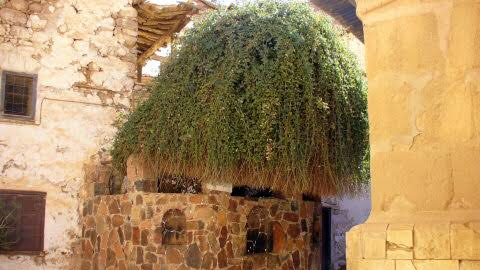
There are three attractions at St Catherine’s Monastery; the church, the burning bush and the library.
We now know that only one of these attractions had an imminent closing time. Given his conduct, Ramesses was equally ignorant of the fact that the library – and her priceless relics – closed at 12 noon.
Between the Monastery gate and the Monastery proper, there is climb of some 500 metres. Ramesses could have casually glanced at his watch, noted that the library was about to close, and suggested we take one of the available taxis to save time. Indeed, we now know why follow cruise passengers were being ushered to the available vehicles with some urgency by their (better informed and more competent) guides. Rather than rush, we trudged up the hill and meandered towards the Monastery – waddling like four lazy Egyptian camels after a month in the desert – as valuable minutes flew by.
Once at the Monastery, the fog of ignorance in Ramesses’ brain thickened. The library, with its fascinating artefacts, lay to our left and the church lay directly ahead. A course to the left would have seen us enter the library with ample minutes to spare, yet we were ushered forward into the Church instead.
Further valuable time was wasted as Ramesses paused by the burning bush for photographs and reminder of tales we already knew from religious studies at school. The burning bush could have waited. When we came back, it was still yet to burst into flame, so it’s not like we missed anything.
Finally, we strode with purpose towards the library door, only to see it closing firmly shut. All attempts to persuade the custodians to allow us entry fell on deaf and unsympathetic ears. Not even St Catherine, herself, could intervene to cause the library doors to miraculously open!
The real tragedy was soon to reveal its face. Everybody who made it into the library in time was heard to remark about how simply marvellous it was. What made the whole experience truly aggravating, however, was the way Ramesses looked so utterly baffled when we told him that we had been denied entry.
“What,” Ramesses raised a perplexed eyebrow, “they told you it was closed?”
He just had no idea.
Further aggravation was soon to follow.
Next on our tour was snorkeling at a reputedly spectacular coral reef at Dahab, on the Red Sea coastline, followed by lunch.
Despite our disappointment, we climbed back into the mini-van with renewed vigour. As the vehicle trundled down the hill, Ramesses raised the subject of the lunch menu. He offered fish and we accepted on the condition that it was fresh.
The concept of ‘fresh fish’ – like most abstract concepts – confused Ramesses. Explaining to him that we only wanted to eat fish if it was caught that day and cooked within five minutes of it being placed on the table to be consumed was akin to demanding that he immediately part the Red Sea.
R resorted to saying that we wanted to see the fish before it was cooked and watch it being placed on the grill.
“Huh,” Ramesses chuckled in abject befuddlement, “you want to see the fish?”
Further discussion about the ancient mysteries of fresh fish, however, was soon swept aside as the true drama of the day began to unfold.
Our driver – probably, himself, dreaming about the lunch which awaited him – brought the mini-van to a halt at the security check-point at the exit from St Catherine’s. Suddenly, animated discussion in Arabic filled the air.
The suited gentleman from the Ministry of Egyptian Tourism – and his semi-automatic weapon – left the vehicle and stood face to face with the security guards. Those of us in the vehicle who did not speak Arabic, watched the drama unfold in hushed silence. A black cat was seen stealthily crossing the road ahead.
Our confusion, and rising tension, was not eased when the driver moved the car to the side of the road and Ramesses – in his state of perpetual baffledom – muttered that he would go and see what was going on. What he learned (if anything) remained unknown as he was next seen smoking a cigarette and fiddling with his mobile phone.
The four of us were left in the car, unsure of what was happening, for over half an hour. The gallows humour which dominated our transit of the Gulf of Aden returned.
Eventually, Huckleberry B urged me to go and request particulars from the man who called himself a guide. To date, the contents of his head had been as barren as the surrounding desert, but we figured he was as good a source of information as any.
Once I found him, Ramesses told me that we could not leave until the security convoy gathered at 1pm. Not wishing to be ostentatious, I had left my watch on the ship, so I asked Ramesses to tell me the time. He said it was 12.43 (although I later learned that he had inflated his answer by almost one third; it was only 12.23).
I cross-examined him as to why he had not told us what was going on and he shrugged his shoulders and mumbled something about the government.
Back in the mini-van the mood had turned hostile.
R proposed we seize the available weaponry and take charge of the vehicle. P was more circumspect. Eventually, we agreed to invite Ramesses back to the mini-van to discuss the options available to us. A small band of UN peace-keepers would have been handy at this juncture.
Truthfully, we had all had enough. We told Ramesses that when the convoy commenced we wanted to go back to the ship. It was already almost 1pm and a three-hour journey lay ahead of us. Given that we had to be back onboard by 5pm, there was simply no time for lunch or snorkeling. All it took was some further unexpected delay and we would have been compelled to spend the night in an abandoned shipping container at the bleak port of Sharm-el-Sheikh. Whilst the company would have been fine, I feared casualties by dawn’s morning light.
Given the way the day had unfolded, we may have been detained at one of the five police checkpoints which lay between us and the safety of our vessel. A militant herd of diseased Egyptian desert goats may have impeded our progress. That black cat was still lurking, threateningly, by the side of the road, inspecting us closely through the corner of her evil yellow eyes. Who knew what other, as yet, unknown dangers lay ahead?
Jokes aside, the presence of an armed escort in our vehicle and the need to travel in a convoy implied genuine security concerns. It was time to go home.
Despite the passion of our appeal and the strength of our argument, Ramesses the Turd remained bemused and befuddled.
“What,” he asked in conspicuous consternation, “you want to change the program?”
This was too much for R. She abandoned her shy and introspective demeanour and cut loose. Why didn’t Ramesses know about the convoy? Why weren’t we offered lunch at the Monastery whilst we waited for the convoy to gather? Did Ramesses have an IQ greater than the stray dog which just trotted by? Who the hell doesn’t know the difference between fresh fish and pre-cooked, once frozen, inedible muck?
I sensed that, by this point Ramesses, had lost control of the conversation…
In an extremely ill-advised move, he resolved to fight back and blame us, his clients, for the calamity. He argued that if we had joined him at 6am, all of the problems which befell us could have been avoided.
Suddenly, all four of us were provoked into a less than civil rhetorical ass-kicking.
In short summary, we pointed out that unless he expected us to swim ashore it was simply impossible to arrive at the port before the tender boats started to operate after the ship had been cleared by the Egyptian authorities. We got there as soon as we could.
P concluded the combined verbal battery with words of profound understatement; “We are not happy.”
Incredibly, Ramesses responded by stating that he, too, was unhappy and proceeded to slam the door of the mini-van shut.
When the convoy was eventually ready to commence its treacherous journey across the Sinai Desert – and faced with the choice of either re-joining us or seizing the nearest camel to ride back – Ramesses skulked into the back of the mini-van and sat behind us. For the entire, extended journey back to Sharm-el-Sheikh, Ramesses remained mute and declined to further interact with us.
Even when safely at the Port, our host remained in the vehicle after we had climbed out. It was only after Huckleberry B enquired whether he proposed saying goodbye that Ramesses said through clenched teeth, and with lashings of sarcasm; “Bye guys”.
He would have been better off remaining silent. The use of ‘guys’ only invited R to deliver a further rebuke for his lack of respect and courtesy. I can only imagine what Arabic swear words filled the mini-van after we left.
Ironically, it was a memorable day.
Over six hours in a mini-van and nothing to show for it but five minutes in a church, a burning bush which looked no different from our shrubs at home, some admittedly stunning scenery and a story we will doubtless be telling for many years to come.
NEPAL | December 2011
Landing on a Wing and a Prayer
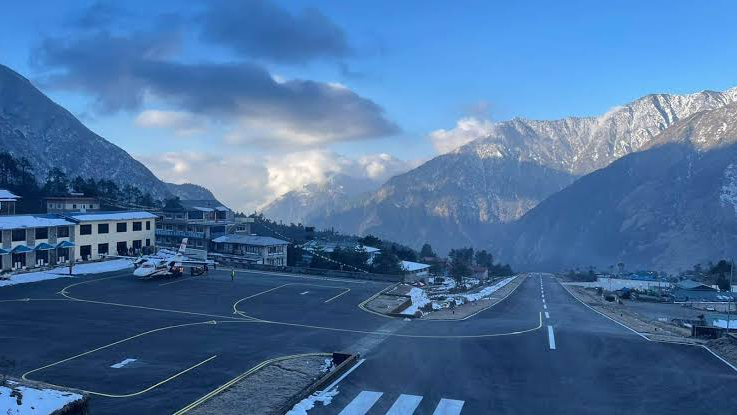
We have heard that the airstrip at Lukla is the second most dangerous in the world.
We believe what we’ve heard…
Cut into the side of a mountain – 2,800 metres above sea level – the runway is only 500 metres long. At the end of this shortest of short runways, stands a very solid rock cliff face. As if these danger factors were not enough, the runway has been built so that it runs uphill.
I have never landed an aeroplane.
However, even if I was an experienced pilot, I anticipate being somewhat daunted by a number of factors when landing at Lukla.
First, I would be anxious to avoid coming in too low and crashing into the side of the mountain below the airstrip.
Second, I would be vigilant in ensuring that my airspeed was just right; namely slow enough to allow me to bring the aircraft to a safe halt on the short airstrip yet fast enough to avoid stalling and crashing into the said mountain.
Third, I would want to set the wheels of the plane down as close to the start of the airstrip as possible – to give myself maximum stopping range – whilst, again, avoiding coming in too shallow and crashing into the cliff face below the airstrip.
Fourth, I would endeavour to keep the nose of my aeroplane up, even whilst landing, in order to avoid the nose cutting a canal through the centre of the upward slopping airstrip.
Fifth, even after safely setting the wheels of the plane onto the tarmac, and avoiding the nose ploughing into the incline, I would be keen to hit the brakes at the earliest opportunity, and maybe even fishtail a litte, to avoid careering into the cliff-face lying in wait at the end of the 500 metre airstrip.
Finally, I would keep a watchful eye for the sharp right hand turn in the L-shaped airstrip and to come to a final safe halt.
Considering each of the above factors, it is little wonder that each of the passengers in our small aeroplane – including the hostess and the co-pilot – applauded the pilot for his well-executed landing.
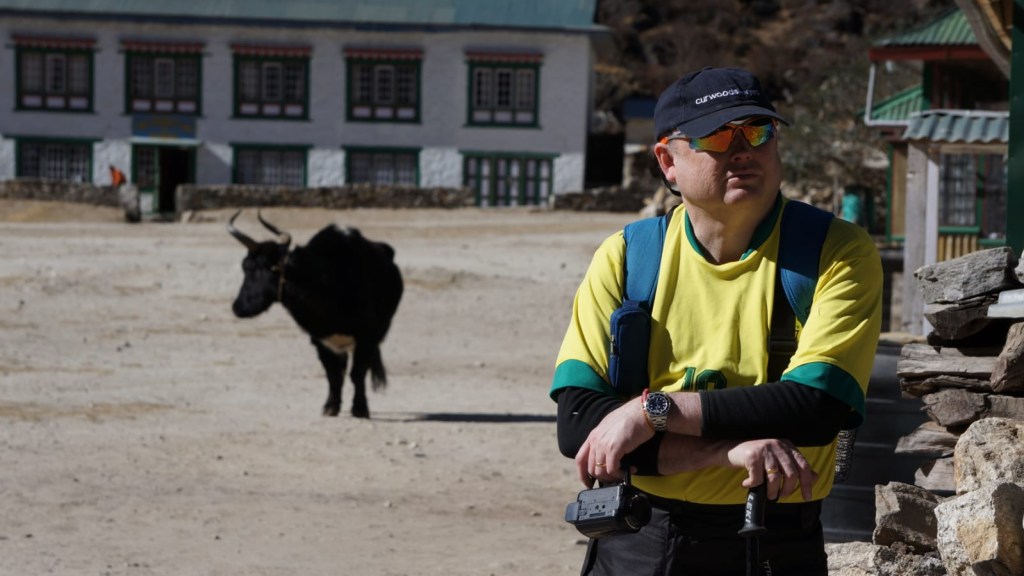
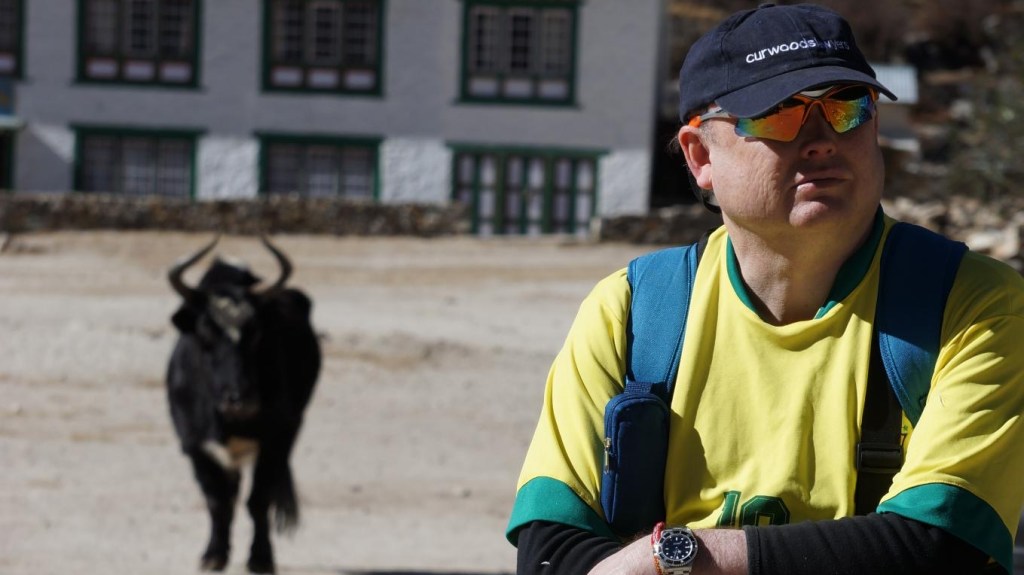
Stairway to Heaven
I have already described the pain we all experienced in long days of trekking along a meandering path of either dust or stone, up and down (mostly up) steep mountains and across only relatively stable suspension bridges.
I must also emphasise the profound pleasure we each experienced.
There is something strangely uplifting – even spiritual – about seeing our planet at its most majestic.
From our second day on foot, soaring mountains kept a watchful eye over our progress. They were our constant friends. For the most part, we were walking along paths which either cut through a pine forest or zig-zagged up the side of a mountain. Our immediate surroundings were frequently of a greyish-green colour.
However, beyond the peaks in our immediate vicinity stood towering, snow covered mountains which were – literally and without any hint of exaggeration – the highest in the world. The tallest reached over 8 kilometres above sea level. Given that we were typically standing between 3.5 and 4 kilometres above the level of the sea, the highest peaks which dominated our view rose a further 4 kilometres or more above us into the heavens.
Of course, Mount Everest was the highlight. Seeing Everest so close that you felt like you could reach out and touch her made the heart soar. I paused to contemplate, once more, the enormous courage and sense of conquest which took men like Sir Edmund Hillary and Sherpa Tenzing Norgay all the way to the distant Summit.
Thankfully, we were blessed, throughout our journey, with ideal weather. Once we started walking we were rarely cold. Moreover, the perfectly crisp winter days allowed us an unimpeded view of the snow-clad Himalayan mountains set against a deep blue sky. Truly spectacular!
At times all I wanted to do was stand, with arms outstretched, and a let out a primal roar of unrestrained joy.
JORDAN | October 2011
Dawn at the Dead Sea
Not surprisingly, we woke well before sunrise after our prolonged slumber. Huckleberry B and I had independently decided that a swim in the Dead Sea before breakfast would be nice.
And so it was that we embarked on the ten minute stroll from our room down to the beach. We did so in semi-darkness and, wearing beachwear, doubtless baffled several groundskeepers along the way.
I will probably remember entering the historic Dead Sea waters just before the Jordanian dawn as one of my most cherished travel memories.
The Dead Sea is reasonably calm, although small waves were in evidence and there was certainly a current below the surface. Across the waters we could see Israel and the disputed West Bank, which was represented by a sharp, desolate escarpment. In the semi-darkness, we could see lights flickering in the outskirts of Jerusalem.
As the sun rose behind us in the East, the West Bank escarpment was turned from a dark purple to a progressively lighter shade of pink. That barren, desert landscape had been Jordanian until the Six Day War in 1967. It looked peaceful, albeit rather unforgiving, from where we floated in the water.
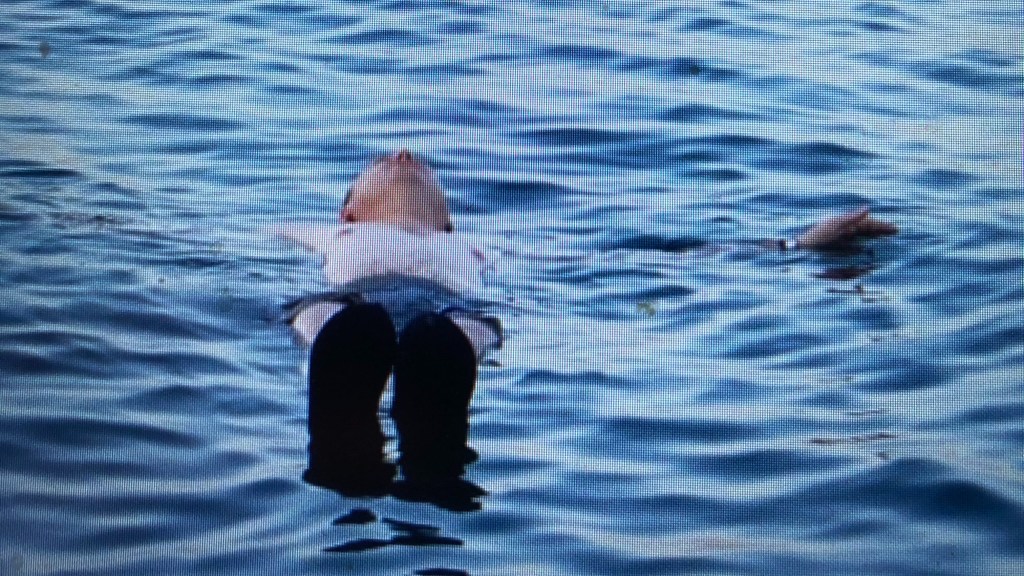
There is certainly something different about the water in the Dead Sea. Despite the early hour, it was remarkably warm. And what we heard in high school was true; once horizontal, we could float without any need to manipulate our arms or legs. We simply formed a spreadeagle, put our heads back, and gazed upwards to the light blue and orange morning sky, still adorned by a corpulent crescent moon.
When upright, I found myself bobbing in the water like a cork; my personal Plimsoll Line well out of the water.
As the sun began to dominate the sky – and other early risers began to enter the water – we left the Dead Sea and headed back up the hill to our room.
MURMANSK | July 2011
Shades of Soviet Grey
After several picturesque ports along the Norwegian coast, our vessel docked in the Russian port of Murmansk.
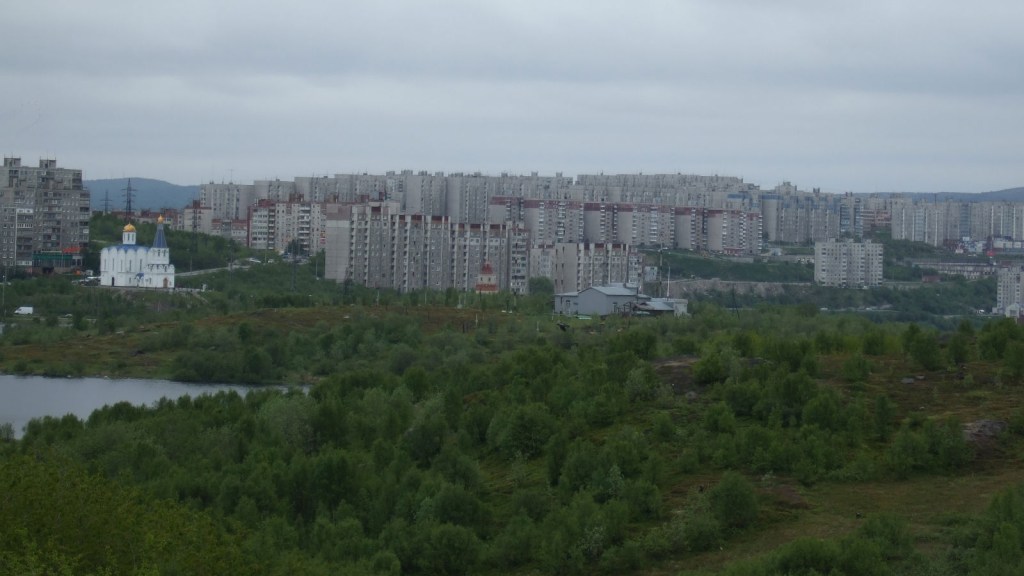
Reputedly the largest city north of the Arctic Circle, Murmansk is set amongst a beautiful natural landscape which includes a deep harbour and wooded hills which roll away to the south.
It would take dedication and several decades of hard work to turn this pleasing natural topography into an ugly place to live, but the Russians have succeeded in proletariat spades.
From the moment we boarded the Cold-War era bus which met us at the dock and took us into the city, our eyes were opened wide in an effort to comprehend how uninspiring and unattractive a port city could look.
Our guide explained to us that most of the architecture could be divided into three distinct eras; the Stalin era, the Khrushchev era and the Brezhnev era. Whilst an eye trained in the joys of Soviet architecture may have been able to spot subtle differences in the building styles championed by these leading Communist dictators, they all clearly had one thing in common; dismal, dreary and desolate ugliness.
The buildings are so similar in design that our guide was compelled to tell the story of a friend who left a party briefly to visit the outside loo only to find, upon his return, that he could no longer identify which door led to his friend’s apartment. The most surprising aspect of this tale, from my point of view, was that anybody bothered hosting a party in Murmansk.
The city seems to consist of little more than stevedoring cranes standing against a background dominated by row-upon-row of bleak grey apartment blocks. The occasional construction stood out as a feature building because it may have been painted in a more pleasing shade of grey. However, even the former KGB headquarters – always said to be housed in the grandest building of any Soviet town – were cheerless and miserable.
Interestingly, we learned during our tour that Murmansk had only been a blight on the Russian landscape since 1916 when Czar Nicholas II ordered the construction of port outside the reach of the German Navy, with whom Russia was at war. Murmansk was chosen because, despite being well beyond the Arctic Circle, the climate was relatively mild, thanks to the famed Gulf Stream, and the port would rarely freeze during winter. Throughout both World Wars, Great Britain and America brought essential supplies to their Russian allies through the port at Murmansk. Despite its gloomy exterior, the port certainly serves a purpose.
At the end of our tour, our rattling little uncomfortable Soviet-era bus brought us back to the port and returned us to the comforts of Ocean Princess.
ZAGAN | October 2010
Walking In the Steps of the Great Escapers
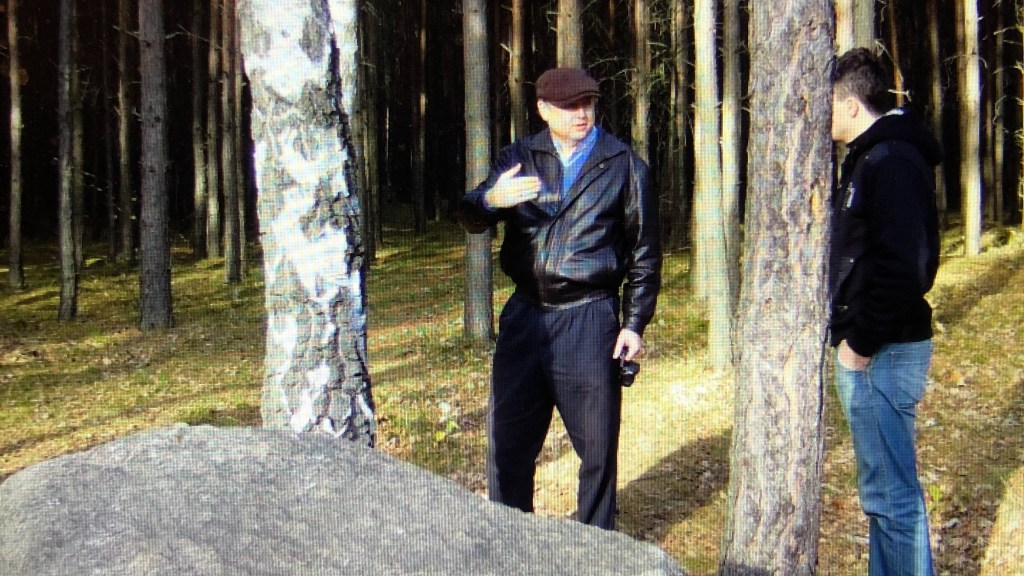
Walking around the remains of Stalag Luft III was one of the most enthralling experiences of my travelling life. Hucklerry B, who had also seen the movie many times, was familiar with the story and seemed to be enjoying herself too. Jay, our Czech guide, had never heard of The Great Escape, but had read up about it on Wikipedia the night before. He was thrilled to have a new World War II site to offer to his clients.
The remains of the foundations of each of the huts in the compound were still in place. It was an easy task for historians to identify Hut 104. At some point – I suspect quite recently – somebody had laid down a concrete outline of Harry on the surface of the ground, with concrete memorials at each end to make Harry’s entrance and exit points.
So, we walked along Harry’s path and imagined the tunnel which once lay 10 metres below. I first saw the movie when I was nine and I first read Paul Brickhill’s book shortly thereafter. I had no difficulty imagining what it must have felt like to travel through that tunnel on the night of the escape.
Next, the three of us traced the escapers’ likely steps through the woods towards Zagan train station. What struck all three of us was how narrow the Fir Trees were. If a man attempted to hide behind one of them, he would be lucky if it obscured one of his legs. Whilst there were a vast number of trees, none of them were very thick.
Narrowing my eyes, I tried to imagine what it must have felt like to be imprisoned for two or three years and suddenly find oneself, out here, in the woods, trying to get away. I’d imagine it must have been more frightening than thrilling. After all, for all its faults, the prison camp was, at least, safe.
We headed back towards the camp and walked amongst the remains of North Compound. We located the Hospital Building and, with a smirk, walked across what remained of the concrete floor of `the Cooler’. These buildings and others were marked by notice boards which had been erected at some point.
The compound itself has now been taken over by trees and, if it were not for the foundations of the buildings which once stood there, would now be indistinguishable from the rest of the forest. We were, however, able to locate Hut 120, where Roger Bushell lived during his time at Stalag Luft III. My knowledge of the layout of the camp allowed me to point to the direction where we might find Huts 122 and 123, where Dick and Tom were built all those years ago.
After leaving the camp, we located the cemetery where a memorial was built by the prisoners, dedicated to the fifty who were murdered by the Gestapo following the escape. The cemetery also features a general memorial which the prisoners built in order to commemorate those who died in Stalag Luft III during the war. Rather poignantly, the inscription described the period of the war as `1939 to 194_’. The last digit was never completed; at the time of construction, the prisoners did not know when the war was going to end.
I truly relished my time at the site of Stalag Luft III. It appealed to that bashful young boy – who always found the world so full of wonder – who lives eternally within my heart.
CHINA | December 2009
A Night in a Chinese Farmhouse (Thank God for Stupid Peruvian Beanies)
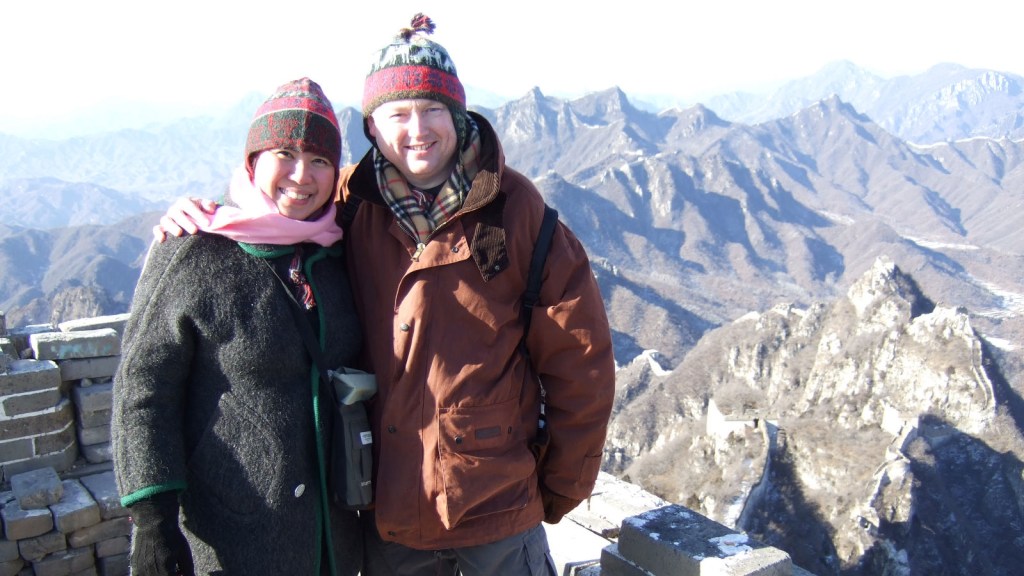
Staying at a Chinese farmhouse, north-west of Beijing, in the shadow of a seldom-walked section of the Great Wall sounded like a great idea!
Arriving a little after midnight – in arctic weather with snow on the ground – we were shown to a room smaller than the average city office. Looking around we both tried to hide our burgeoning horror when we realised that there was no apparent form of heating in the room. Zipping up my overcoat, I braced myself for my battle with hypothermia.
Welcome to China!
Morbid thoughts of our sad demise were, however, interrupted by our guide explaining that our bed was constructed of mud brick which, he assured us, absorbed heat. We would be very snug under our blankets, so he claimed.
I felt compelled to test his theory by placing my palm under the thin blanket. Compared to the blizzard gusting through the small room, the mud bricks, indeed, exhibited some vague properties of heat. However, I was yet to be convinced.
As it turned out, there was some truth in the guide’s assurances. After a death-defying change into our pajamas, we each pulled two blankets over our heads and lay as still as possible. It only took us five minutes to cease shivering, however, once this happy state was achieved, we were reasonably warm and comfortable.
At this point I must pause to thank Huckleberry B for the alpaca wool beanies we purchased in Peru last year. They remain the stupidest looking headwear I have ever seen – complete with ear flaps and ridiculous colours – however on that thermally challenging night in a Chinese farmhouse north-west of Beijing, my stupid Peruvian alpaca wool beanie was the only thing standing between me and the loss of my ears to frostbite!
And so, we dozed off to sleep, earnestly praying that the call of nature would not awake us during the night and compel a treacherous journey to the outdoor (Chinese-style) toilet lying some twenty dark and frozen metres from the door to our room. Had such an urgent need arisen, it would have been a difficult decision whether to heed the call and brave the sub-zero temperature outside or to grimly hold on through the night. And the notion of exposing vulnerable – but precious – flesh to the diabolical arctic chill was a harrowing thought, not worthy or even sub-conscious contemplation.
Even the arrival of dawn did not bring significant relief. Whilst pleased to have survived the night, our dismal room remained extremely cold outside the safe haven of our blankets. Even changing into our day clothes compelled strategic thinking in order to minimize our exposure to the chill. I ended up piling my blankets over my chest whilst pulling on my pants and putting my shirt and jumper on over my night-shirt. Even when fully dressed, with multiple layers and a heavy winter jacket, the cold fingers of the morning air still found their way through our clothes to chill the flesh below.
Outside, a dripping tap now sported a long, icy stalactite.
When we looked skywards, however, our hearts combusted with joy when we saw a crescent moon hovering adjacent to the Great Wall perched on a mountain peak above us. What an awesome sight!
Welcome to China!
PERU | October 2008
Upward, Ever Upward
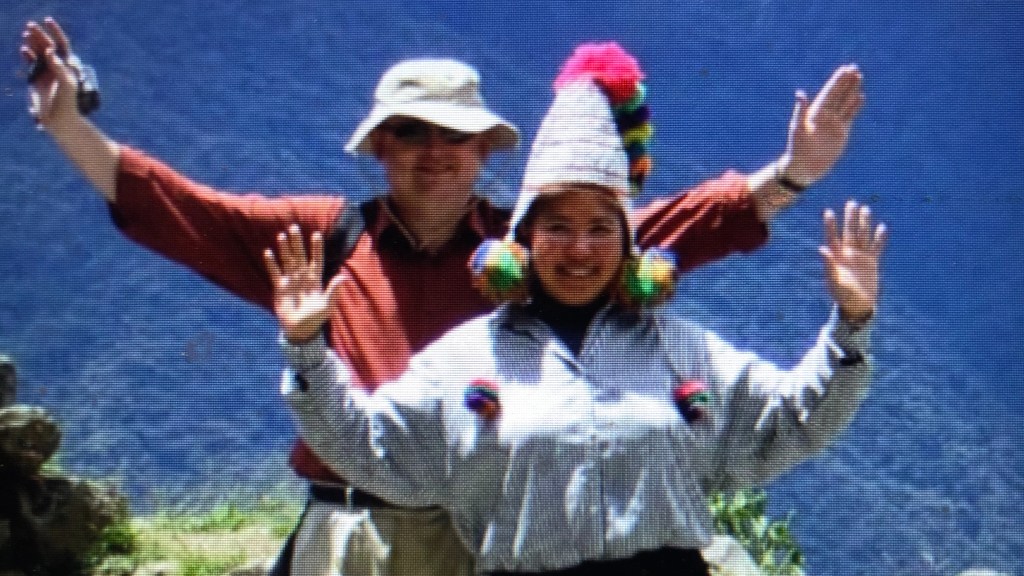
We arose early on 2 November in order to secure an early place in the line to climb Wayna Picchu, as only 400 people are allowed through the gate each day. Half are permitted to commence their trek at 7am and the other half are given numbered tickets and asked to return at 10am.
As it turned out, Huckleberry B and I arrived at the gate at 5am and were first in line. However, it was not long before we had company.
At the foot of the mountain, we were already 2.4 kms above sea level. The peak stood just under 3 kms above the waves. And our route took us, essentially, straight up.
Added to the sheer height and the lack of oxygen was the variability of the rocky steps. At times, we had to place our feet on a step which was only big enough for one heel. Other times the next step had an elevation up to our knee.
To make matters even more difficult, it started to drizzle as our journey commenced.
Upward, ever upward, we climbed – around bends and over boulders – upward, ever upward. There were times when the path was so narrow that two people could barely pass. Occasionally, a misplaced foot might see us falling down a cliff face. There were some who preferred to climb the steps by crawling on hands and knees!
I reminded Huckleberry B that the activity was not compulsory and that we could turn back at any time. There were times when I secretly hoped that she’d agree.
After about 45 minutes – with regular breaks to catch our breath – we reached an area where the Incas had built some structures. We knew we must be close to the peak. However, those dastardly Incas never make things easy. In order to reach the summit, we had to walk through a cave and – holding our stomachs in – squeeze through a narrow opening before climbing a ladder to get to the next level.
Once at the summit, however, we were exhilarated. The view would have been awe-inspiring had it not been for the clouds!
I am happy to admit that despite being first in line, we were not the first to the peak. Some young whippets beat us to the top. However, Huckleberry B was the first female, so we are proud of her for that!
JAPAN | December 2007
The Fairytale Lunch
Although lunch may have been an unnecessary indulgence, that is not necessarily to say that we did not indulge!
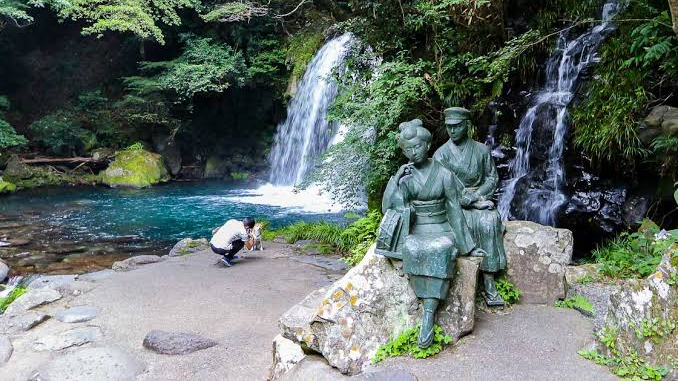
On our first day at Unryu, Huckleberry B and I went for a walk around the local area, which featured a shallow mountain steam punctuated by seven picturesque waterfalls. Sparkling fresh water flowed from some unknown source above us, paused in swollen pools before cascading down each waterfall and splashing loudly on the rocks below.
We walked along a footpath which had been constructed, through the forest, occasionally crossing the stream on well-constructed suspension bridges.
After a time, we came across a sign which indicated that a restaurant lay at the end of a path which diverted from the well-worn track along the river. Given that it would be some time until dinner – albeit only a short time since our bountiful breakfast – Huck B and I decided to have some lunch, so we climbed the steep, rocky steps which had been cut into the hillside and followed the path into the woods…
Before long we came across a small house amongst the pine trees. It was a ramshackle construction with smoke billowing from a small chimney. Once at the front door, we were welcomed by a small man with a toothy grin, before we were ushered down a cluttered hall, up a ladder and into the attic of the building!
Entering the attic, we were met by some workers who had just finished their meals. They gathered their tools, climbed down the ladder and marched back into the woods – whistling as they went – to resume their work.
Meanwhile we were directed to a small table in the corner…
Given the circumstances, I would not have been surprised if, peering through the attic window, we should have spied a girl with a little red riding hood skipping down the path or if an elderly woman had entered the room and offered us some gingerbread to eat from her house.
Sadly, none of these enchanted events transpired. However, we did enjoy the cold soba noodles and malt beer which were on offer…
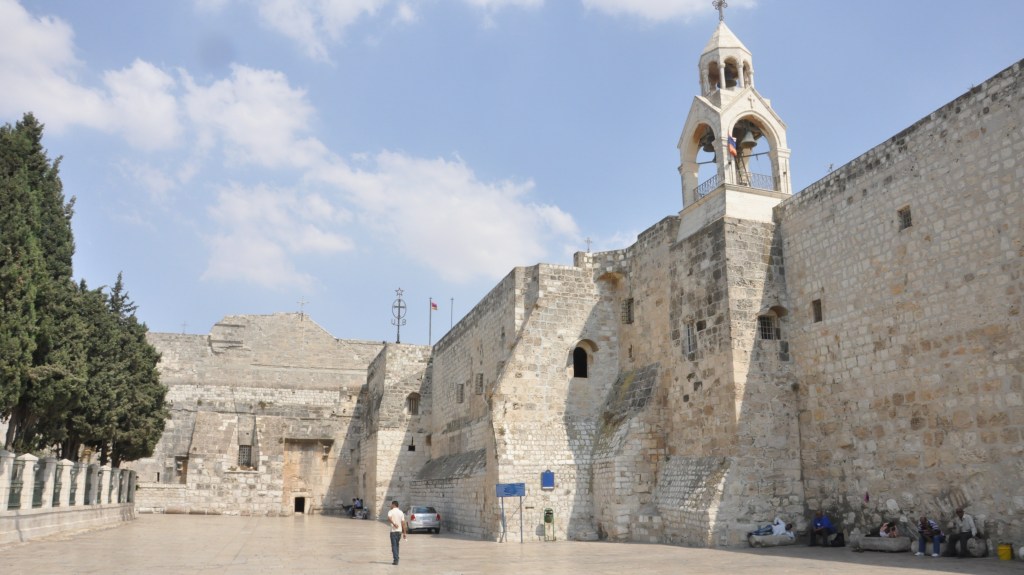
BETHLEHEM | October 2007
“Bethlehem is Not a Good Place, My Friend…”
I am not a religious person and am certainly not a strong believer. Whilst I was raised as a Methodist and attended an Anglican school, if asked, I would say I am Agnostic.
However, I know my biblical stories and have a keen interest in history. I have no difficulty accepting that a charismatic man named Jesus lived 2000 years ago and led a new religious movement. My issue is not with Jesus’ existence but with his divinity.
So, it was with some anticipation that Huckleberry B and I visited Bethlehem. Given the indoctrination I received as a child, I had visions of a small town, a shining star, three wise men and a babe in a manger. The reality was quite different and rather disturbing.
The mood within the Palestinian Authority is quite different to the mood outside. We saw the Israeli checkpoint where Israeli soldiers – fully armed and tense – checked the credentials of those travelling from within the Palestinian Authority into Israel proper. We also saw the large fence the Israelis have constructed along the border.
Most notably neither our guide, Avi, nor his car were allowed into Bethlehem. Avi did not explain what would happen if he drove in, however, we can assume the worst. Instead, somewhat like hostages, we were driven to a safe meeting point where we swapped cars and a Palestinian guide took us into Bethlehem to see the Church of the Nativity, where Christ is said to have been born.
Whilst the rest of Israel is ordered, clean, purposeful and full of vegetation, Bethlehem was squalid, dirty, somewhat chaotic and barren. And it was somehom unwelcoming.
Our Palestinian guide – a Christian himself – said that most Palestinian Christians have left Bethlehem to live overseas. He, himself, was contemplating a move to Europe. He remarked several times that Bethlehem was “not a good place”.
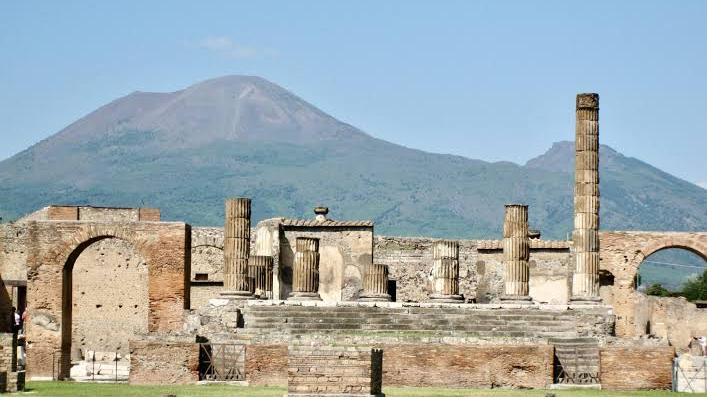
POMPEII | October 2007
The Whitest of White Togas
As strolled amongst the ruins of Pompeii – my mind drifting to memories of High School Latin – our guide conveyed an intriguing anecdote. She recited that candidates for political office in Pompeii conveyed their lofty ideals by wearing the whitest possible clothing. This was achieved, rather ironically in my view, by bleaching the cloth in urine. Whilst human urine was used, evidently the best results were achieved through the medium of camel urine as a bleaching agent.
This story brought to mind the following possible exchange between Minimus and Maximus.
MINIMUS: Okay, we’ve tried cat piss and rhino piss, which gives us the brightest white?
MAXIMUS: You haven’t commented on my new toga yet…
MIN: Your toga?
MAX: Yup, I wore it especially for you, but you don’t even notice… You never do…
MIN: It’s a toga. Looks just like any other toga. What’s wrong with you?
MAX: Just thought you’d notice, that’s all…
MIN: Look! We’ve gotta focus. You know we get a week’s free entry to the bath house if we find the best bleach. Now which is it? Cat piss or rhino piss?
MAX: You know what we haven’t tried yet? Camel urine! I reckon we should give camel urine a whirl!
MIN: Camel piss? Why camel piss?
MAX: They’ve got two humps! Increases the uric acid or something. There’s an independent study on the subject. Saw it published on the wall of the market place.
MIN: Independent study? Have you smoking that stuff Potus Headius has been growing again?
MAX: Nope. Pretty confident though. What’ya reckon?
MIN: What do I reckon? I reckon you’re an idiot. There’s more chance of the Roman Empire falling than there is of you being right. There’s more chance of whatshisname from Nazareth being the son of God. I reckon you’d get better odds from Andrology of Totalius that this whole city will be buried in lava than you would of camel piss producing the brightest white. That’s what I reckon!
MAX: So what’ya think of my new toga? Pretty white, don’t you think?
MIN: Of course it’s white! It’s a new toga. All new togas are white! Would’ya stop banging on about your bloody new toga.
MAX: It’s my old toga. Washed it in camel urine!
MIN: That’s a beautiful toga!
MAX: Praise Jupiter! Free entry to the bath house here we come!
MIN: Where’d you find a camel anyway…

